
Well he would, wouldn't he?
Tell 'em, Mandy.

The Creature in the Open
A talk I recently gave at the Institute of Psychoanalysis…
Part 2 of 3

Well he would, wouldn’t he? Often misquoted as He would say that, wouldn’t he, but this is from the transcript, this is what she actually said.
She is Mandy Rice-Davies, one of two young women – along with Christine Keeler – embroiled in the Profumo Scandal. Though they were smeared as prostitutes or worse at the time and ever since, they were in fact just two teenage girls who wanted to be models, who fell in with various Establishment players, and were spat out at the convenience of those wretched movers and shakers we know so well. Mandy’s comment was made during the trial of the doomed Stephen Ward, and was met with raucous laughter in the courtroom. By 1979 it was in the Oxford Dictionary of Quotations, where it will remain, I imagine, in perpetuity.
The real work in this question is being done by the word Well. A playwright might have skipped that, made the retort arch or smug: He would, wouldn’t he. But Mandy’s well is generous, demotic, humane, embracing, like Come on, we all know what’s going on here, don’t we?
Because we do. Obviously Lord Astor denied the relationship – a denial which was pretty demonstrably a lie – and he denied it because of who he was and because of who she was.
(By the way, if you want to know who Mandy was, she once described her whole life as ‘one slow descent into respectability,’ suggesting her famously witty retort was not a one-off.)
But Mandy Rice-Davies’s comment is rightly legendary because it affirms that people say what they say because they are who they are. It’s a very simple proposition, but let’s apply it to writers and say people write what they write because they are what they are.
This is appropriately camp, in the sense of being frivolous about what one is most serious. Yet the implication of the proposition sent me down the following byway: what fixity, what principle, what authority does all literary criticism stand upon, when all opinions, all memories, all learning, language, culture, are stacked upon each other in the higher regions of the brain? So, through our poetical lens, Plato, Dr Johnson, Eliot, Leavis, Helen Vendler, Marjorie Perloff – well they would say that, wouldn’t they, because they are who they are…
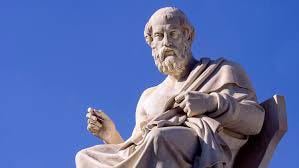
[Plato in action]
This made me think of the formulation I learned across the road last year at the Maudsley, observing the work of the Outreach team in the city, hearing the essential mantra of the recently adopted analytic protocol known as the Power Threat Meaning Framework. When encountering a client – patient – service user – soul in need of help – one is no longer to ask What’s wrong with you? One asks What happened to you?
I’m aware this is contentious ground between the castles of psychiatry, classic psychoanalysis, person-centred therapy, even social work and the operation of the law, and as one roaming those grounds, I’m both reluctant – no in fact wholly as unready as Ethelred – to stand still and hold forth, but it does serve as a reminder of the relationship between a fixed position and the flow of time.
Seen this way, a poem – and a poem is a Creature in the Open, for the Open is nothing but my new name for White Space, and the poem no more than a Creature scuttling for its life in the face of inexorable Time – has nothing inherently wrong with it. It is not dying by the light of any deep authority. It is not mistaken. This is a difficult proposition for a poetry professor to face – but I don’t care which poetry professor is talking to me, from Plato to Perloff – you say what you say because you are who you are.
What’s wrong with you in the world of writing means what’s wrong with you by my lights?
Of course this applies to the patriarchal protocols of canonical literature, but it also applies to what calls itself progressive, avant garde. What applies to ancient poesy applies equally to the poetries and the keepers of poetics. All these castles seem to be fortified by the barbed-wire of Latinate, Victorian, pseudo-scientific diction. It is purposely made hard to understand, and none of that is necessary.
Poetry is in bad need of a Winnicott, with his going-on-being, his not-me object, his good-enough parent, someone to mine the meaningful speech in the echoing caves of Anglo-Saxon. If you must read criticism, make damn sure you know who’s speaking to you, why they’re saying what they do, why they’re talking how they do. Remember Mandy in the High Court, that Creature in the Open. Well he would, wouldn’t he.
*
I don’t know how I got here. I mean I really don’t. Saying there’s nothing wrong with any poem. You mean anything goes??? Jesus, I was mentored by Walcott and Brodsky. Of course I’m saying what I say because I am what I am, but here’s a little true story to shed some light:
One of my current students at the Poetry School came to one of our Open Days, trying to decide whether to apply for my course. In fact he came to the Open Day three times in different years before taking the plunge – this story has a pleasantly triune, fairytale quality to it – and here’s how he described what he found on each occasion. This is verbatim, I asked him to put his experience in writing and said I’d be using it here:
1. First I was concerned you might be a formalist and might require me to toe the line which was frightening and I did not apply.
2. The next time I felt you were not a formalist but were very interested in form and I did start applying but didn’t submit as I doubted my work.
3. Then the third time I felt you had softened to the extent that I had to apply, as the ‘reformed formalist’ backstory was actually someone I really wanted poking around in my poems.
So this story happened to me as well as to him.
I did indeed, once, think there was a line to be toed. When I began teaching I had a sense that poetry should cleave to the ancient forms, and since I mostly wrote like that I thought I could help the stricken, wounded poems that came my way – What’s wrong with you? – towards a healthy conclusion, like the worst kind of therapist, knowing the answers before really knowing the patient. What I’m describing is an inclination builded upon my particular heritage, education, kindred, culture and so on. Well I would say that, wouldn’t I.
My understanding of poetry changed over the years when I started thinking primally. About humankind in the early light of the savannah, about how we might find landscapes beautiful because they show us ways to survive, to make it to safety as Creatures in the Open. I started to hear the heartbeat, the pulse, the breath as it comes and goes like the tide, to see footprints in the sand. This resulted in my most compressed and I think sustaining formulation: your poetry cannot be freer than you are. Your poetry too is in thrall to mortality.
To think primally – of the earliest of us – is to think kindly, in all the depth and grace possessed by that old word kind. In our sister language German of course it means child, and not for the first time today I am reminded of that splendid formulation:
‘There is nobody on earth but women and their children.’
For poetry is not anything goes, there really is a job for me, or there’s only one but it is the one I’m doing. For I believe the authority of truth and beauty – which are indeed all ye need to know – is creaturely, in fact I would say the authority is mammalian. Forms survive in spite of our neo-cortical or limbic inclinations. Late nineteenth-century rhyme and meter lost track of the creature, sure, there was a calcification, an unthinking faith in metrical authority, and it was time for change.
But so much of the poetry written in my lifetime, post-modernism, post-post modernism – it’s always in the post, isn’t it? – seems to me to stem from a repression of song, a repression of song on intellectual grounds, just one more way to lose track of the creature. Without song you cannot warn, you cannot plead, you cannot keen, you cannot get the species dancing so it never forgets.
A further risk to the truth of the body is in the false promise of the marketplace: this is the way it sounds now, so make that sound and make your mark. That’s exactly the stuff that disappears. All that the marketing people say to the newly accepted poet is – all the poets here know this – how many followers do you have on social media? That’s how it dies, right there.

At this high-middle age I finally see what Plato meant when he banished poetry from his ideal republic.
Most of his reasons for excluding poetry are silly – it corrupts women, it corrupts the youth, it shows gods might have weaknesses etc – well he would say that, wouldn’t he? Given the culture, the heritage, the history of his time and place…
What remains is his point about imitation. That poetry is an imitation of an imitation of the ideal. That it belies a divine authority. As a non-believer, I’d always been inclined to bin this idea with the stuff about women and children, but if you replace the gods with nature, with what I have always called creatureliness – by which I mean kindness as in truth by the lights of our kind, though I’ll take the gentler meanings too – then most suddenly I agree with Plato.
If poetry fails by the lights of the creature, heartbeat, oxygen, footfall, it belies the authority of humankind, indeed, as I’ve come to believe, the authority of mammalian kind.
That authority makes itself known in the clear voice of each individual: what happened to you? which is not to say anything goes. It is not anything goes, it is seeking a creaturely truth that can fight for its life in the Open, against the acid erosion of Time passing. It is the absolute opposite of anything goes, because the work of poetry is nothing less than clearing the way for song in a creature. If the song is clear, the creature can be found by its kind, can find them, can help or be helped by them. The path to that realm is narrow, but it is not signposted anything goes…

I always think, if in doubt, let’s meet back here. It’s the first day in the life of the creature, no one’s listening, so I’ll tell you what I think. I think the Rainbow is the means to survival of our kind, and the means to destruction goes by the name of Barcode. Barcode is the binary world, the digital realm, where things are right or wrong, black or white, true of false. Rainbow is – you know what Rainbow is, all the colours, all the others, everything between and beyond. What’s happened in recent time is that our newest Promethean challenges – the computer, the internet, AI – have turbocharged the Barcode.
I no longer think in terms of left and right politics. There are regions of the left that are pure Barcode: cancellation is a Barcode move, for example. These days when I think of the survival or destruction of our kind, I think of the Barcode and the Rainbow.
In psychoanalytical terms, the closest concept to this is Melanie Klein’s positions: the depressive position (this being Klein that’s the good one) in which the infant learns that the good breast and the bad breast belong to the same person, and internalises that to absorb the vital and life-affirming concept that one person can be both good and bad – as against the paranoid-schizoid position, in which the infant never grasps this, and grows up thinking those who aren’t entirely good are entirely evil. Klein’s paranoid-schizoid position and my Barcode-Rainbow business look the same to me.
American politics suggests that the digital realm, the algorithmic spell, is explicitly designed to make people think that way, the binary way, and rewards those who do, or at least gives them pleasure while wasting their time and spoiling their lives. It’s easy to see why the venal and the ignorant would support what’s being inflicted on America, more puzzling to see why professed Christians would fall in behind – until you think of religion itself in Barcode terms.
The beautiful religions of the world are full of mystery, the imponderable and the Rainbow – the worst religions are pure Barcode, this is right, this is wrong, by the Book, no other book, indeed no other books at all.
That’s as dark as this gets, let’s talk about this man…
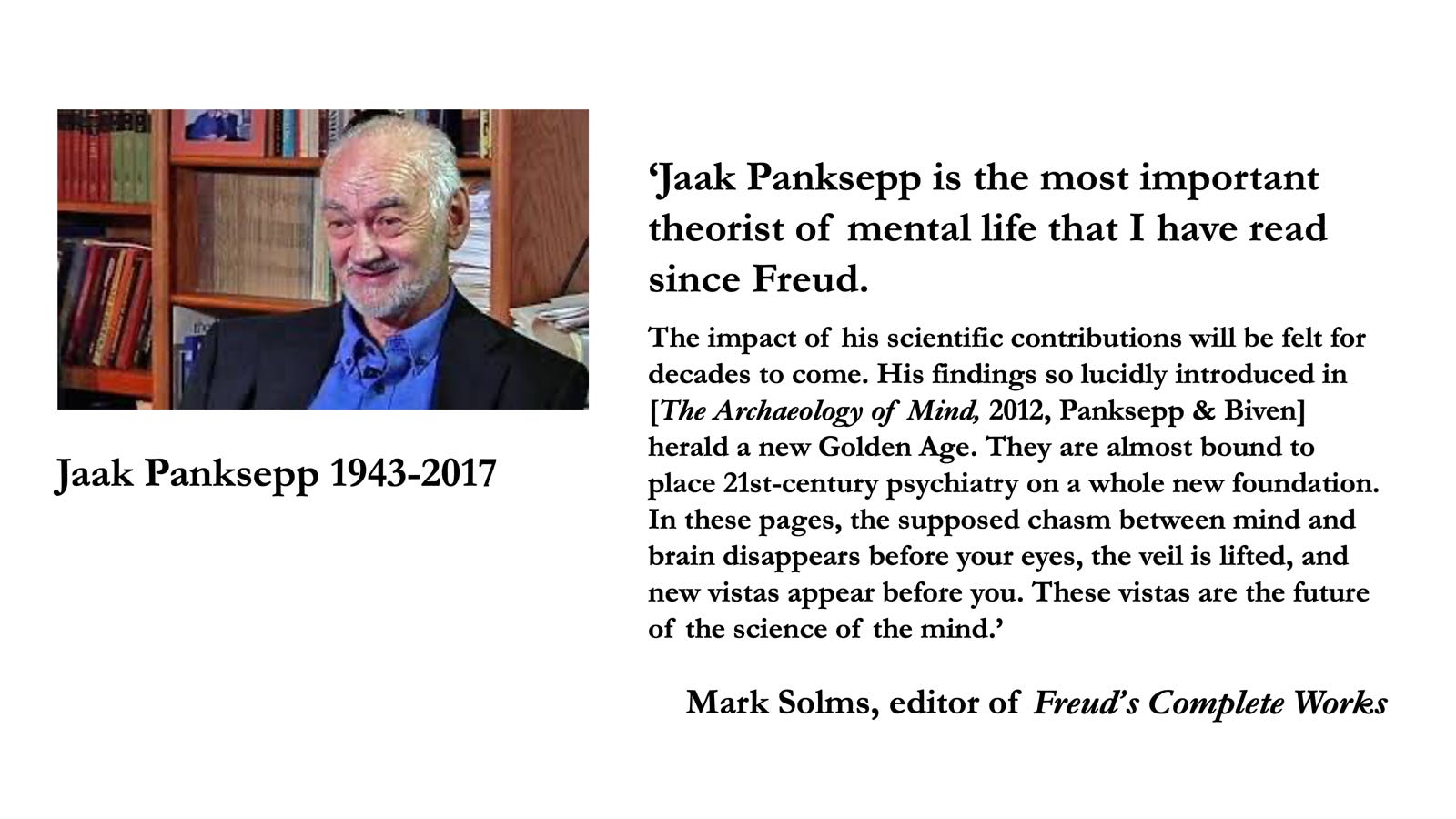
I encountered the neuroscience of Jaak Panksepp less than a year ago, when I saw it listed on the curriculum for my art therapy training. I listened to his TED talk and went from there. The encounter feels life-changing to me, but you can tell I don’t like evangelicals, so I’ll tread with caution.
What’s important on this slide is who’s writing the encomium. The South African psychiatrist Mark Solms is the editor of Freud’s Complete Works, he is one of the world’s most eminent Freudians. Yet another example of what a cathedral Freud is – you can see beauty and grace and truth all around, even if you don’t believe all the words on the stained glass, or indeed any of them at all. Auden put it best in his sublime elegy of 1939:
if often he was wrong and, at times, absurd,
to us he is no more a person
now but a whole climate of opinion…
So I’ll try to be succinct. Jaak Panksepp, till his death from cancer in 2017 – was an Estonian-American neuroscientist who pioneered – and indeed coined the name for – Affective Neuroscience, basically the field of how emotions are made. He ploughed a lonely furrow for many years, as behavioural science dominated the late 20th-century scene, and basically shut down the idea that animals really felt emotions at all. Animals were puppets, they reacted by homeostatic instincts; to say they actually felt emotions was anthropomorphic.
Sometimes the behaviourists remind me of the schools of poets from the mid 20th century till now who appear so terrified of suggesting or revealing emotion that they’ve all but suffocated music.
But Panksepp and his associates persisted, and amassed mountains of empirical evidence for the existence of seven emotional systems in the brainstem, that is, seven primal systems shared with all mammals, in the oldest, deepest locations of the brain.
Brainstem Theory is not the only game in town. Feedback Theory holds that humans create emotions in the higher areas of the brain, with the uniquely human elements making cognitive sense of sensations, which differentiates Man from everything else. Personally speaking, this Linnaen concept – Man as above and beyond all creatures – fails for me on the criteria of Intuition and Imagination, but even on the ground of Reason I doubt it. To be continued… Panksepp was a Darwinian, we share what we share with the mammals. There’s rarely a last word in science, and this contested ground goes on being contested, but one can at least say this:
Whatever the neurological mechanisms are by which we feel emotions, the seven primary systems are there.
Jaak Panksepp and others mapped them out, one or two of them he literally discovered. When Mark Solms compares him to Freud, one has to think of ways in which Freud’s Imaginative or Intuitive renditions of Science and Reason are so convincing that they have struck their roots deep into human understanding.
A prime example might be the so-called Structural Model – the ego, super-ego and id – this concept has been of immeasurable value to our understanding of the mind – though the fact that The Onion magazine was able to say in November 2016 AMERICA ELECTS ITS ID without having to explain the term didn’t stop America doing it again in 2024, so the immeasurable value is perhaps relative.
The point is not whether Freud was right about it - time has proved him right about it in terms of imaginative truth - it’s that you can’t point to the ego, super-ego or id on a brain-scan. Whereas Panksepp’s seven systems are literally right there, empirically present, a common bond of mammalian life, below what we think we know, or feel we think, or know we feel.
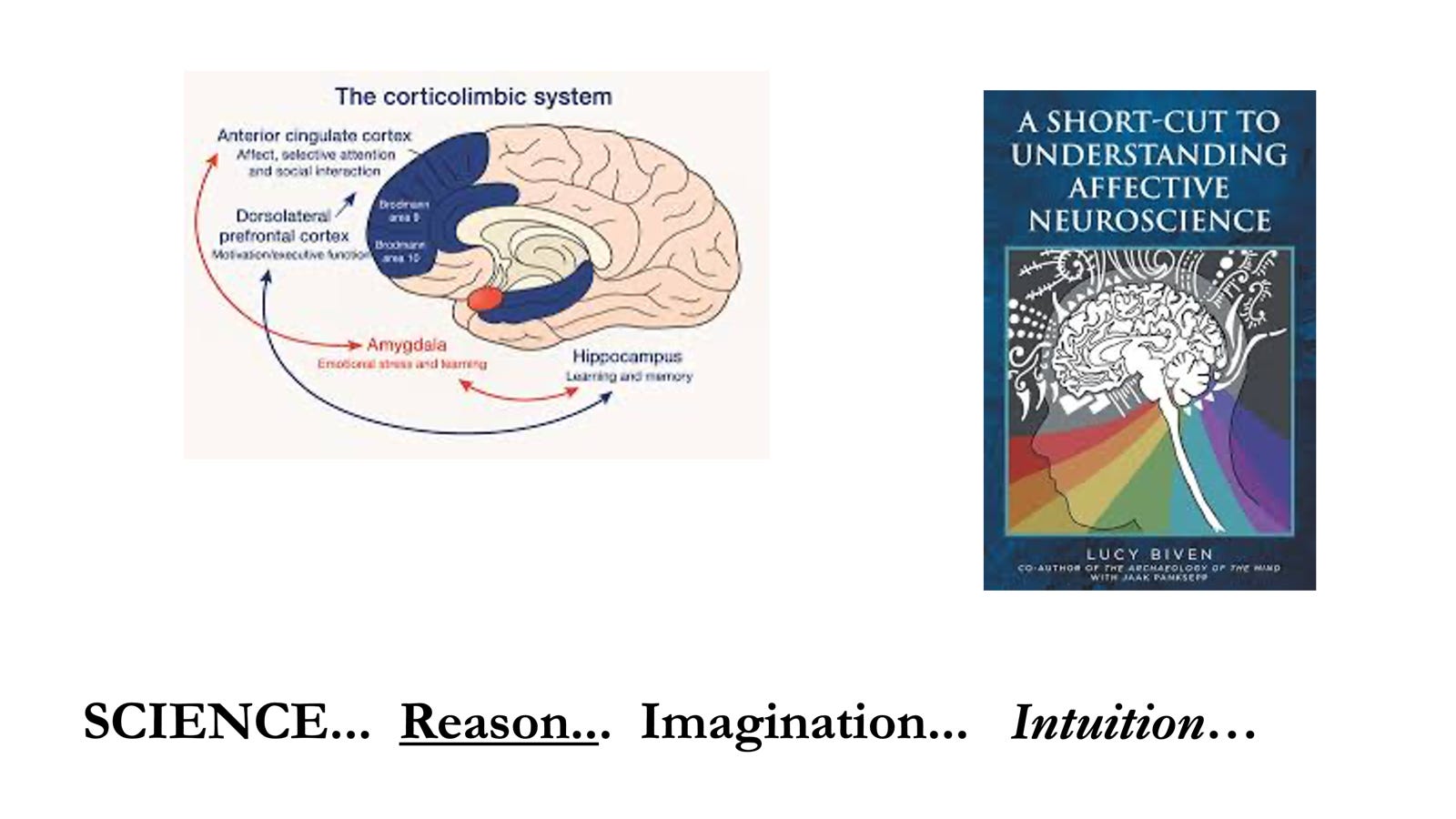
This is just here to underline that point. The diagram on the left is Reason making sense of Science: this is a diagram of brain structure and functions. The one on the right is a book-cover, and is Imagination making sense of Reason – the book being a very fine and clear explanation of all the contesting theories of the our day, written by Lucy Biven who co-wrote The Archaeology of the Mind with Panksepp.
Let’s bear in mind that it literally has a rainbow in it, seven strands of emotion. I know it doesn’t literally look like that inside!
And yet, if Freud’s structural model (Id, Ego, Super-ego) can be rendered as an iceberg – Freud himself suggested we see it that way – Panksepp’s systems can be seen as a rainbow of seven colours twined together at the brain-stem. In fact, many neuroscientists (including Mark Solms) say that a tiny region of the brainstem – the periaqueductal gray, or PAG – is composed of precisely that, at least with seven columns, if not the iridescent light-display that given half a chance I would fondly imagine.
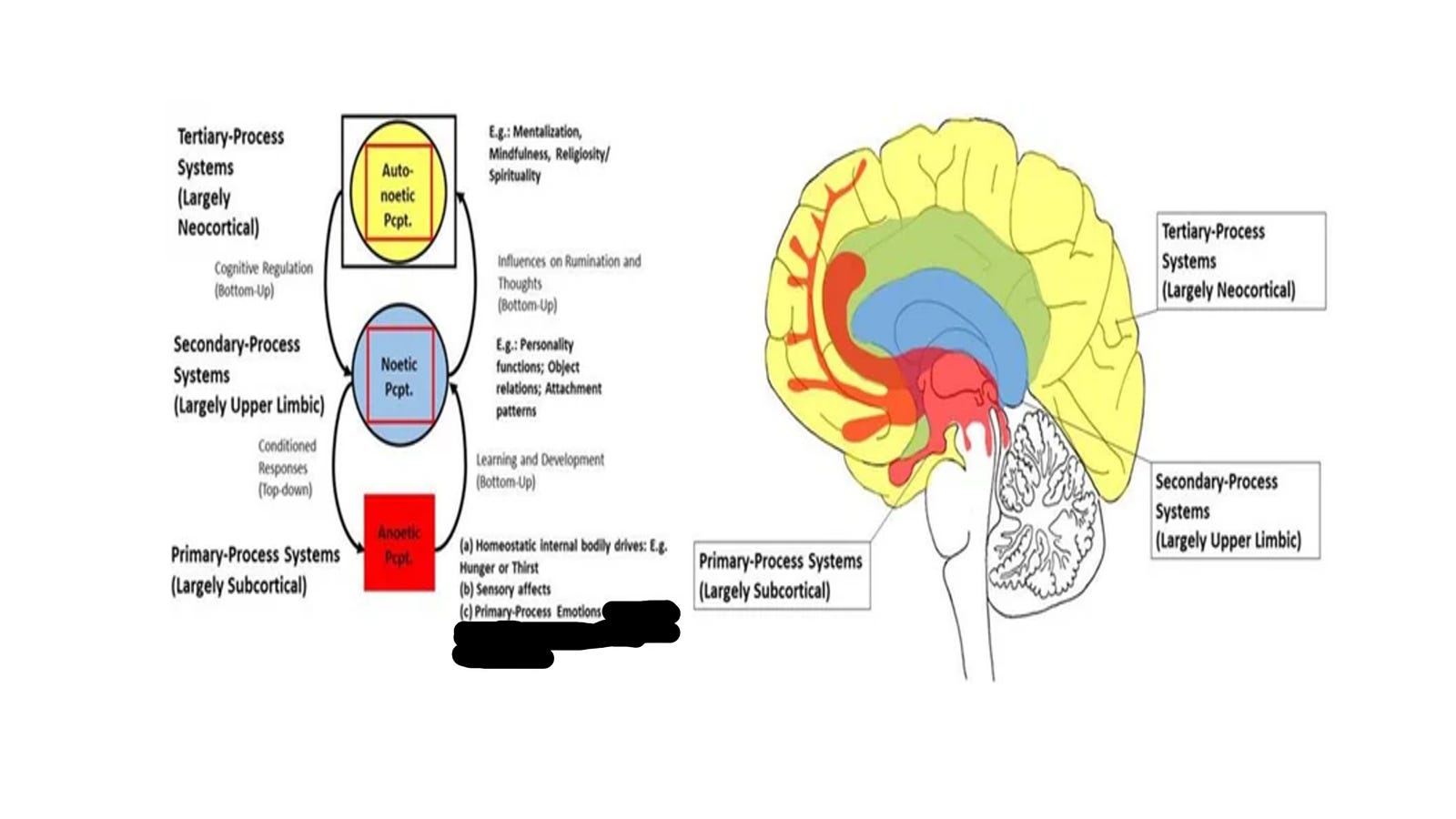
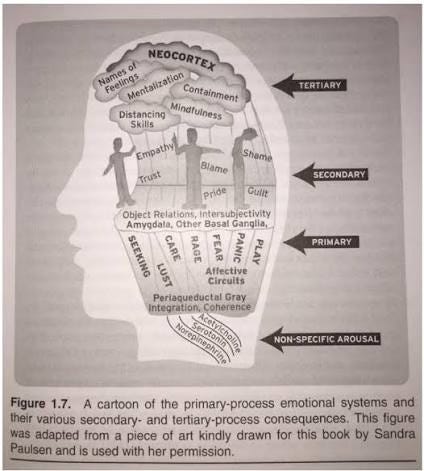
The stuff in this slide isn’t especially contested. The yellow is the Tertiary-Process Systems, largely neo-cortical, the outer and newer stuff basically, that we don’t share with the other mammals, language, abstract thought, logic, planning, spirituality. The blue is the Secondary-Process Systems, the upper limbic, memories, functions of personality, object relations, attachment patterns, the stuff you can file under well we would, wouldn’t we. The green stuff is – I dunno, it doesn’t say, Arsenal? – and the red stuff, the oldest, deepest stuff, the Primary-Process systems below the cortex, hunger, thirst and so on, sensory affects, pain, and there, right down there, is where we find Panksepp’s seven emotional systems. The Brainstem Theory is that we share these with every other mammal, and well, let’s meet them…