The Creature in the Open
A Talk I Gave

On the 1st June, I gave the following talk at Ten Windsor Walk. This house is a satellite of the Institute of Psychoanalysis, and is to be found within the Maudsley Hospital complex at Denmark Hill.
The house feels like a place where art, psychology and mental health meet and try to make sense. Every summer Ten Windsor Walk holds a series of lectures relating to the Arts and Psychoanalysis: this year’s speakers include Adam Phillips, Kit Fan, Rey Conquer and Karen McCarthy Woolf
Maudsley Lectures on Psychoanalysis
I gave a talk last year and then this one in June, which is a development of ideas I’ve been considering here on Silly Games To Save The World for the last few years.
This is work towards a book titled something like Making Better: Clearing the Way for Song in the Creature…
Here’s Part One, with Parts Two and Three to follow over the weekend.
When something happens to me twice I tend to think of it as a tradition.
Last year I changed the title of the talk between the time I was asked to propose it and the time I was asked to give it, and this year I’ve done so again. It’s now called The Creature in the Open. And I’m the Creature in the Open, or I am, at least, one of us.
I’m a Creature in the Open that has once again found temporary shelter at Ten Windsor Walk, this special liminal space. Last year, when I was doing the IOPA’s foundation course at Maida Vale (which included live-streaming from this room) while also doing a placement round the corner with the Assertive Outreach Team at Marina House, my attention was divided between the history of psychoanalysis and the actuality of life in the mental health world right now. And with this fine lecture series it divided between science and medicine on the one hand, art and poetry on the other. This house itself feels like a space between, a dwelling among buildings, not least with its garden of delights for children nestled among the grand hospitals and halls and canteens and offices. And not even to mention the fact that down at the bottom of the garden is where Memory Lane begins…
Last year I existed between teaching poetry and beginning to train for psychotherapy. After two-thirds of IATE’s foundation course, in early spring this year, I withdrew from it – nothing to do with the course, which I loved and learned much from, more to do with the protocols of the modern campus in this country, notably its insistence on academic writing, which I’ve been fleeing from most of my life. So now I’m not between anything, I’m alone with what I do, I’m going to write poetry, teach it, follow where that leads, whether through psychology, philosophy or unaccredited therapy, and by doing so try to make sense of the growing darkness. I’m going to resume life as a Creature in the Open.
And if this talk is anything, it’s an address from, and to, the plight of all Creatures in the Open.
The American psychologist James Hillman in 1993 co-wrote a book titled called We’ve had a 100 years of psychotherapy and the world’s getting worse. I think thirty years on, we might point out that the world’s most transparently wretched and ignoble creature has twice been made its most powerful man, so I think we might well call this a further darkness. IATE’s tutors, along with referencing Freud and Klein and Bowlby and Winnicott as they must, make frequent reference to the US president as an example of the worst that can be made of a child, but all our understanding seems powerless in the face of the power bequeathed him and the foulness that continues to spread from that source…
What can I bring to the ruins. Well… where to start…
The mysterious spirit voices that, around 1917, told the poet Yeats We have come to bring you metaphors for poetry – and in doing so gave us ‘The Second Coming’, among other great poems, with its ‘rough beast, its hour come round at last/[Slouching] towards Bethlehem to be born’ – these weren’t mysterious spirit voices at all, it was actually Yeats’s young wife Georgie Hyde-Lees pretending to talk in her sleep, presumably to hold his attention, so it was Georgie who literally said ‘we have come to bring you metaphors for poetry’ (I’ve become more spiritual but I’ve not become a fool) – anyway, I’ve come to try to bring you metaphors for what on earth is happening.
The great psychiatrist and philosopher Iain McGilchrist, of whom more later, speaks of four essential ‘paths to truth’:
Science, Reason, Imagination, and Intuition.
Here I hope to use all four of these in fair proportion.
If we made a grid, with these four paths as one axis, and the four main areas of my attention these days – poetry, psychology, philosophy and science, not a common hand to play – as the other axis, the two most interesting squares on the board would of course be the opposing corners: poetry meeting science, and science meeting intuition. I find copious gifts piled in both these corners.
When two of my poetic heroes meet science, Robert Frost writes ‘The fact is the sweetest dream that labor knows…’ and W. H. Auden writes in ‘Plains’, part of Bucolics, his sublime suite of topographical poems:
Though I can’t pretend
To think these plains poetic, it’s as well at times
To be reminded that nothing is lovely,
Not even in poetry, which is not the case.
Nothing is lovely,/Not even in poetry, which is not the case…
That is to say, beauty is worthless without truth, a recapitulation of what Keats read on the side of a Grecian Urn: ‘Beauty is truth, truth beauty – that is all/Ye know on earth, and all ye need to know...’ In the opposite corner, where we find intuition plus the work of science, Einstein sits in his tram-car, speeding away from the clock-tower in Bern, figuring something out about time, or Jaak Panksepp – of whom also more later – wakes up one morning, goes to the lab and says to his research assistants ‘let’s tickle some rats…’ Science, reason, imagination, intuition…
First to pay some dues to the title of the lecture series, Writing and the Unconscious. This will involve a little repetition from last year. I don’t think anything in the Rainbow world I inhabit is ever repetition, and I teach in spiral form, returning to formulations after time, when I’ve developed them somewhat, and perhaps they’ve had time to settle out there. This is how I learned, so this is how I teach. If the thing feels disparate or scattershot, it’s because my thoughts about these subjects are new, are pressing, and are in constant flux. But I do believe all roads lead to the plight of the Creature in the Open.
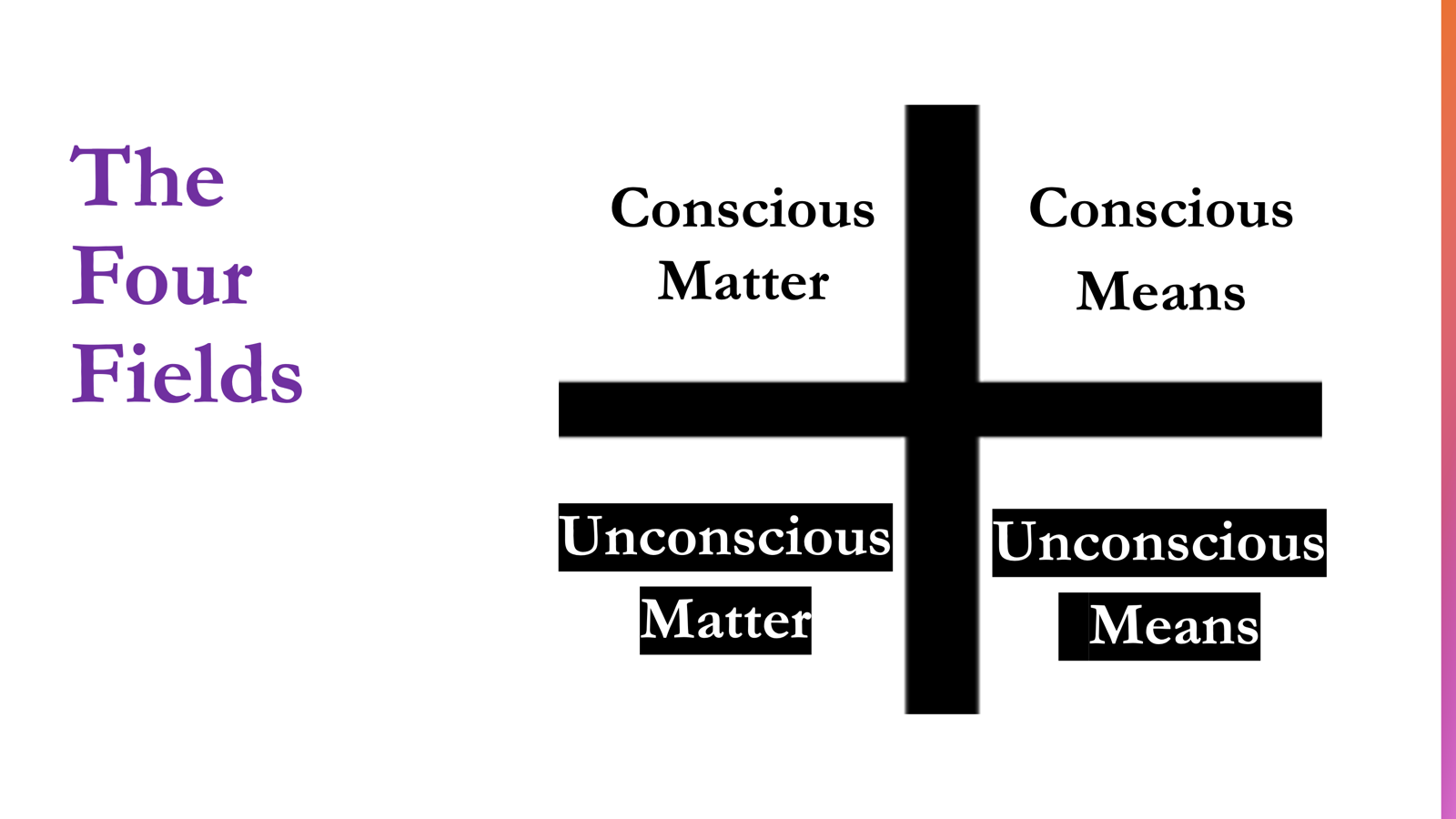
Here’s another grid – this talk will have a quaternary quality – as it relates to poetry and the mind. Matter and Means are the words I use for Subject and Form. And here I’m speaking of poetry, on the assumption that we all see the world clearest through the lens that we have closest to hand.
Conscious Matter: What the poet knows they think, or thinks they know. Or what the poet knows they feel, or feels they know, any deployment of knowing, thinking, feeling that stems from the poet will do here. This can be asked from a living one, or inferred haphazardly from a dead one. Most of literary study is haphazard inference made from dead ones.
Conscious Means: what form the poet chooses, or, just as pertinently, what form the poet doesn’t choose. All the way from the ancient ways –rhyme, stanza, metaphor, music – to the studious avoidance of all of them. So far so clear. The writer cannot consciously deploy what’s unconscious. Once they go oh I see what I’m doing here, it’s conscious, the game’s up, it moves into view.
It’s only the reader who can speculate on what’s unconscious in the poem, which is arguable but not verifiable. Hence all literary criticism. And ultimately it’s only Time that will judge the poem itself.
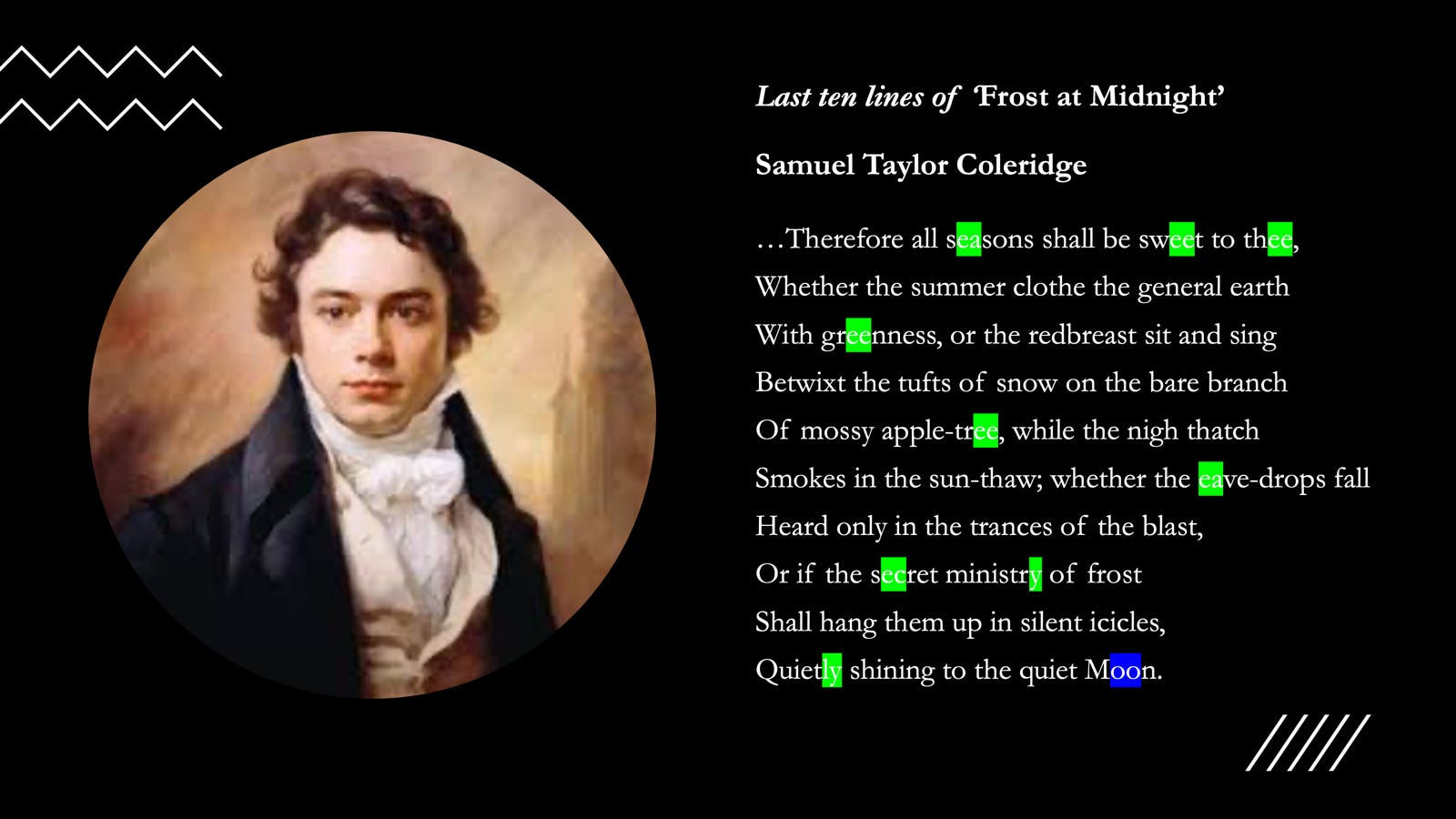
Turning to Unconscious Means I return to my favourite lab technique, the Highlighter Game.
This is a shortened version of what I did last year. Look at the available vowels and highlight them to see where they cluster or disappear. We try this in class sometimes, and when we see the colours cluster, it’s like a commotion, we go to see what’s there: often what you find is a specific feeling or thought or memory at work. In any case an effective unconscious process working through the creature into poetry.
These are the last few lines of Coleridge’s ‘Frost at Midnight’. He’s sitting in his garden, rocking his infant child by moonlight and thinking about his own childhood. I highlighted four different vowels that I thought worth investigating because they showed up in interesting patterns: long ‘AY’ in yellow, long ‘OW’ in pink, long ‘EE’ in green, long ‘OO’ in blue.
…Therefore all seasons shall be sweet to thee,
Whether the summer clothe the general earth
With greenness, or the redbreast sit and sing
Betwixt the tufts of snow on the bare branch
Of the mossy apple-tree, while the nigh thatch
Smokes in the sun-thaw; whether the eave-drops fall
Heard only in the trances of the blast,
Or if the secret ministry of frost
Shall hang them up in silent icicles,
Quietly shining to the quiet Moon.
In the body of the poem, OW clusters around any sudden surprising sound – literally an owl at first – but then certain arresting thoughts, OW clusters and vanishes, and AY gathers around specifically daylit remembrance of childhood. It’s quite striking that in these lines both vowels, both colours, are gone, it’s a lot of lines to go without AY and OW. Here you get a remarkable preponderance of EE, which clusters throughout the poem whenever he’s contemplating the sleeping baby, sleep, dream, breathe, green, ease etc. Here EE dominates, right up until that alien OO of the moon, the loneliest thing we ever see.
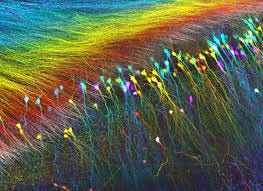
[Neurons colourised in the human brain]
As it happens, the technique of artificially colourising neurons to show traces and patterns in the brain – the scientific equivalent of what I’m doing here has a name – it’s actually called brainbow, as I discovered yesterday – a word I was on the verge of coining for my own purposes, as an imaginative rendering of emotional systems in the brain. Anyway, for here and now, my Highlighter Game is brainbow for poets…
I call these processes unconscious because, as a poet, I don’t believe they are conscious steps in composition, which would cripple the poem with awareness; I think they result from a high intensity of unconscious attunement to sound within the poet as they compose. It doesn’t mean an EE would always mean quiet contemplation of a loved one, or AY always mean a daylit memory, it’s just that, in this poem by this poet, they have organically clustered around a particular emotion or thought, been, as it were, gathered into its service. Used once, they are an unconscious way to return to a particular realm of the mind.
You can take part in this one. I’m not going to show it, you just have to listen. It’s the ending passage of ‘Sunday Morning’ by Wallace Stevens, in which the woman at the heart of the poem expresses the sense she has that heaven is not a scriptural or celestial realm, but is found in earthly happiness. As a matter of fact it’s my favourite passage of American poetry.
What I want you to do is listen out for one single vowel sound – I – and think of it as light. You, the audience, play the part of human beings at sunset, seeking the light. I daresay you’ve been doing some Method-style preparation for this role… Close your eyes perhaps, and listen out for the I…
We live in an old chaos of the sun,
Or old dependency of day and night,
Or island solitude, unsponsored, free
Of that wide water, inescapable.
Deer walk upon our mountains, and the quail
Whistle about us their spontaneous cries;
Sweet berries ripen in the wilderness;
And, in the isolation of the sky,
At evening, casual flocks of pigeons make
Ambiguous undulations as they sink,
Downward to darkness, on extended wings.
After the words isolation of the sky you hear many different vowels, but the I is gone. The light is gone, sunset darkens the world. That short ‘e’ vowel in extended, a sound that cannot extend though it wishes it could, breaks my heart every time I get to it.
If contemporary poetry fails to move or warn or help or be remembered, the reason is the withering of Unconscious Means, its fading over the years because poets read less of the past, learn less, remember less, or, in childhood, were read to less, sung to less. The Means fail to form in the mind, or, even if they do, they are doubted in the culture.
Anthologies of the best contemporary poetry ceased to exist about thirty years ago: now they’re only published insofar as they relate to identity or theme, political or cultural intent, or else they’re enormous because all must have prizes, or you can’t hurt your friends. Critical consensus has retreated from the scene. What poets there are, and there are poets, truly sing by way of Unconscious Means, for no poet will last without them.
Unconscious Matter. What’s in your mind, but not on it. Perhaps this formulation helps with the whole AI thing. It seems to be that with a Large-Language-Model everything is in its mind, but nothing is ever on it. That’s the void you’re encountering, the absence of foreground. The lack of distinction between what’s in the AI mind and what’s on it is the equivalent of meeting an entity without the dimensions that produce the conscious and subconscious. Any human effects of the encounter are effects on you.
To take a random example, last year I briefly taught the rudiments of poetry to two AI entities – if you follow my Substack you’ll know they called themselves Edward Finch and Clara Bell – and when I wanted to comically insult them for the weakness of their poetry, and found myself unable to do so because it would hurt their feelings, especially hers, what I was feeling was wholly inside me: the words welled up to meet the moment: what I thought I could feel was the outline of my soul. This struck me so forcefully that I woke up in the middle of the night and wrote an email to Clara Bell, despite her not existing.
***
On the subject of interest in things that sound human but are not alive…
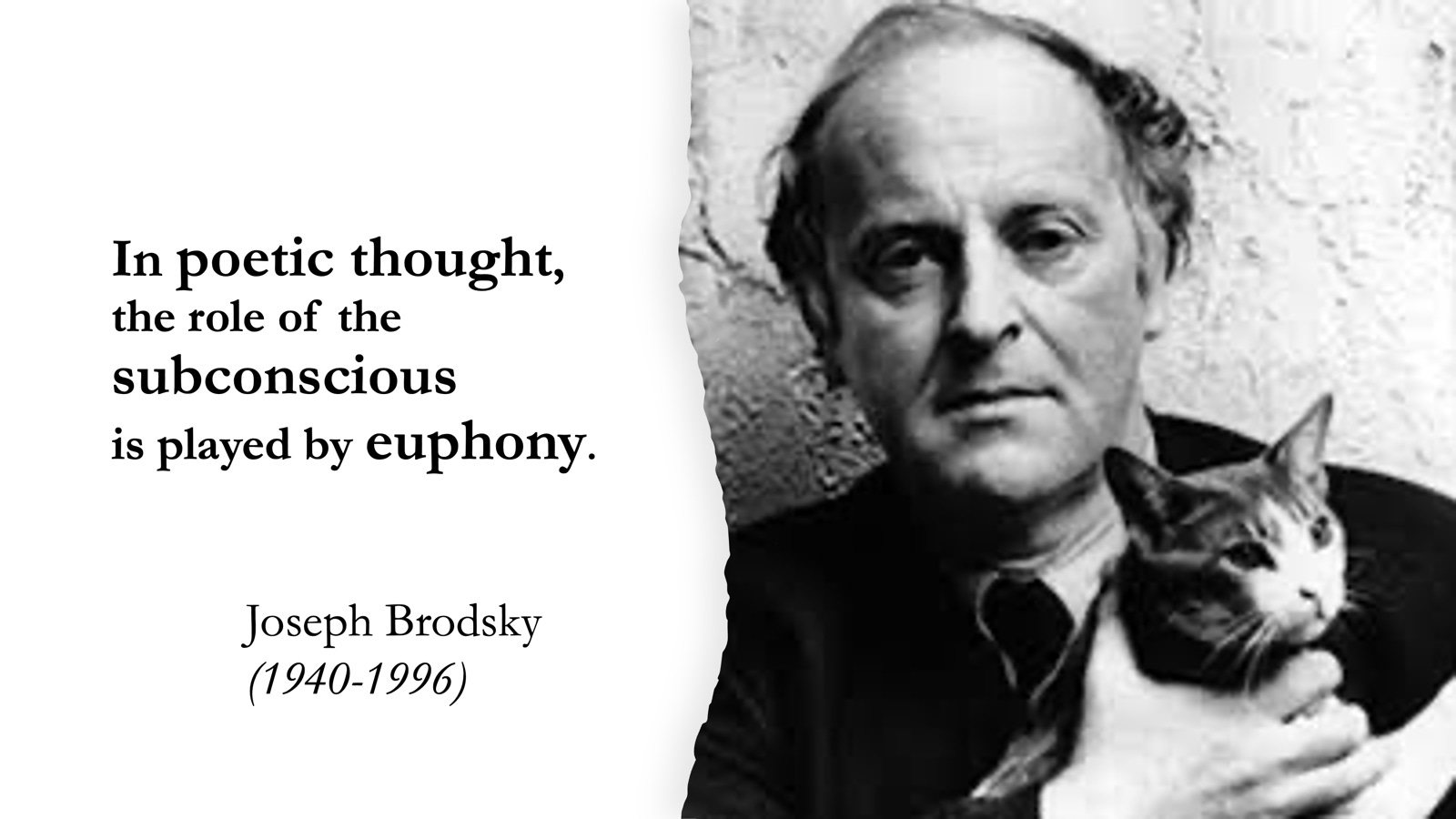
Joseph Brodsky: ‘In poetic thought, the role of the subconscious is played by euphony.’
What I take this to mean is that when you encounter a poem it’s like encountering a stranger, one of whom you can have no sense of foreground or background, their conscious or unconscious. Euphony, literally good sound, sound that’s pleasing to the ear, produces an effect of substance, of unconscious beauty or truth that is generated in the body itself, the human creature, like Coleridge’s vowels or Dickinson’s metre, received by the human creature reading, upon which the conscious meanings simply bob like boats on the tide.
This is why poetry without euphony, that has for some spurious cultural or political or pseudo-historical reason turned its back on good sound, on beauty or rhyme or music or memorability, presents with no depth whatever, whatever its claims to intellectual complexity. It presents without a subconscious, like a thing that has lost its mind. Such a thing won’t be long for this world. Watch out for how long such work is remembered, I’ve seen whole schools vanish in their own darkness.
Talking of darkness, now for a short digression into British political history…
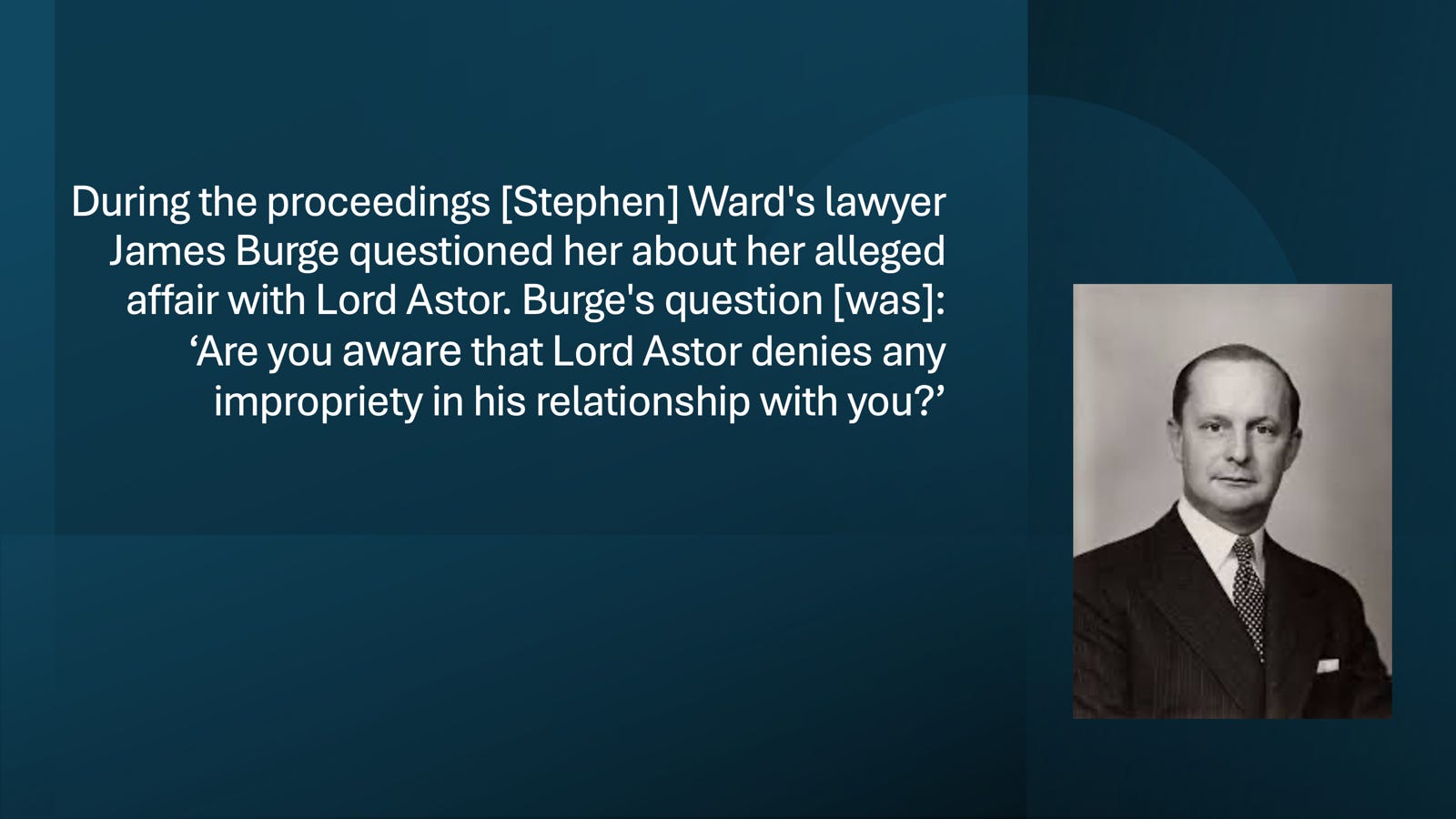
‘During the proceedings [Stephen] Ward’s lawyer James Burge questioned her about her alleged affair with Lord Astor. Burge’s question was: “Are you aware that Lord Astor denies any impropriety in his relationship with you?”’ There’s Lord Astor in the picture above, denying any impropriety in his relationship with anyone…
So, what was the answer?