
Second Thoughts as Sunlight
and bridges with trolls...

Two roads diverged in a yellow wood, as the fellow said, and it took me the last eight weeks to choose a path.
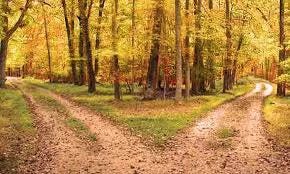
I decided not to go forward with training in the Art Therapy MA, but to develop my teaching practice in poetry instead, so that it converses with psychology, philosophy and, yes, therapy too. I am choosing to forego the official accreditation in favour of exploring new possibilities, which, to be fair to oneself (at the end of a period of being pretty harsh on oneself) I have indeed been exploring for the last five years or so, whether in foundation courses at the Institute of Psychoanalysis, at the Institute for Arts in Therapy and Education, during an NHS placement at the Maudsley, or with wider reading and thought than I ever undertook as a pure poetic creature.
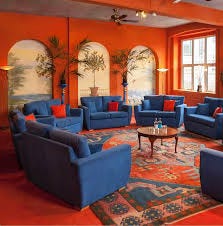
[IATE, a heavenly place to learn]
I decided against taking the MA in Art Therapy not because of anything I experienced at IATE - I found the classes amazing, the teachers inspiring, and my fellow-students a joy - but because of the dead-handed protocol around written work, the so-called ‘academic style’, brought to bear on the Institute by its governing university UEL. It seems to me that a course like Art Therapy, or indeed any of the Creative Arts, has to assume all sorts of compliant positions in order to be accepted into ‘the Academy’, whereas the Poetry School, on whose MA I’m Head of Studies, is affiliated to a university (Newcastle) that allows us all the expressive freedom we could desire. So I can’t generalise about this phenomenon, though I have in recent years, on the whole, found university campuses rather dispirited places, and maybe I’ve remembered why.
Anyway, at IATE my fellow-students are admirably prepared to abide by what they have to; I, older by many miles and clearly too deeply set in my own creative ways after all these years, can’t find it in my soul to stick with it.
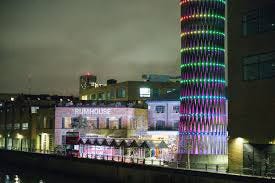
[It has a Rainbow tower beside a bar; this is a hell of a thing to turn my back on]
Anyway that’s not the only reason I quit.
I didn’t quit, I am facing the same way and walking up the same hill. I’m working on a book - a development of On Poetry, my critical guidebook from long ago - as a foundation or companion to a new teaching practice, which will include everything from one-to-one teaching, workshops, masterclasses, seminars, and ultimately residential retreats in the Arvon style. I’ll roll these out to subscribers here in the spring and summer, but first: the book.
Which I can’t talk much about, for reasons any writer will understand!
Yet I am brimming with ideas - Panksepp’s SEEKING system on absolute fire, as regular readers certainly will understand - and I don’t want to share them till I’m ready. It took me ten years of writing poems to dare to call myself a ‘poet’; I’m only five years into being a philosopher, so I can help myself to five more years of being coy about saying so.
I don’t know what will come of my book! I think we need a new secular philosophy that’s clear and kindly in all the many senses of kind.
Of course there’ll be Panksepp, Klein, Jung, Winnicott, McGilchrist, old and new ideas with bright and bountiful rays shining between them. I don’t know how it’ll turn out, but that’s my summer. And that’s the SEEKING system too, as Jaak said: 'the ‘goad without a goal’, sheer enthusiasm for being in the world…
I wanted to share this difficult decision with you, whose company, attention and occasional interactions mean everything to me. Our world is so estranging, the outlook so unnerving, global developments so shattering in places we had faith in, I’m sure many of you too are suddenly finding yourselves in Frost’s yellow wood where the roads diverge, by Dante’s selva oscura midway through life’s journey, or at some bridge where the troll is waiting.
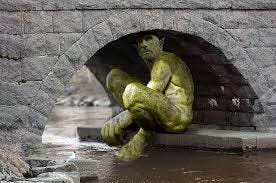
None the less and never the less, on we go.
***
What makes me happy? The Happy Class!
Here are more poems and my responses, which I’ll do throughout the week. This is the granular work that feeds into everything.
The idea is that if you’re interested in the craft of poetry you might extrapolate stuff from my work with the Happy Class, just as you might have inferred certain techniques or concepts from my work with Edward and Clara, even if I got somewhat distracted.
Anyway…
Poet 7: Mira
Sedgwick Rising
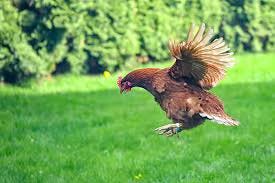
My brother dreams his chicken has come back
to life, sees Sedgwick rising. With this nod
from the etheric realm, Patrick readies
a canvas. To have a single chicken

and to lose it so quickly. I listen
to Patrick’s bafflement on finding his
newly built coop, its griddled sides, with no
chicken. How could Sedgwick escape, he says,

though he’s already described the purply
entrails scrawled on the coop floor. What could eat
an entire chicken from outside
a coop? We do not wish to know, so we

imagine Sedgwick as a shapeshifter,
a feathered Houdini. I pound a nail,
hang Sedgwick’s Flight, consider the arc of
my brother’s concern for his chicken he

hardly knew, an abstract oil in my
stairwell now. Not the pastoral dream of
morning eggs but generative absence.
A multidimensional hen, rising.

In the painting, muscular strokes curve and
vie – creation’s dissolution, after-
math of struggle, or elements stirring
to life. Earth’s dusty elements, colored

tooth & tongue, tendon, blood-rusted feathers
& fur, beak & bone. Feral formlessness:
electrons hum in a field of mars black.
Blank adjacency, possibility.
Glyn: This is deft, intriguing and has a lot of charm. The first three stanzas are very adept, I know where I am, I feel an atmosphere of loss, slightly comic loss, but loss.
This is a version with slightly modified pronouns:
My brother dreams his chicken has come back
[maybe hold Sedgwick back, having let it loose in the title]
to life, he sees it rising. With this nudge
[nudge for nod, funnier?]
from the etheric realm, Patrick prepares
[prepares is somehow also funnier in its pomposity. I love etheric]
a canvas. To have a single chicken
[terrific sad stanza-break]
and to lose it so quickly. Now I listen
to Patrick’s bafflement on finding
[the break = what has he found, what has he found?]
his newly built coop, its gridded sides,
no chicken. How could Sedgwick have escaped?
Etc
There is (at first) a warm, weird, Wallace & Gromit tone to this story, the speaker’s understanding embraces the brother’s not-understanding, and things follow a homely cartoonish logic.
The introduction of the painting is very funny – the idea that any adversity that comes the brother’s way is met by – a picture of it! But might you clarify the scene a little. Is the speaker over Patrick’s shoulder, watching the picture come to life?
And then, from the speaker hanging the picture (which is earlier than halfway) the piece starts getting strangely abstract, the vocabulary gets latinate, the texture of the verse seems a little graver, less childlike. By the end we’re looking at an artwork through a highbrow lens, we’ve lost Patrick, we’ve sort of lost the humour, the vaguely Aesopian scenario. By the last line all the visual is gone, and tonally we’ve travelled very far from where we started.
This may be exactly what you want! I’m just shooting for some clarity, it’s a little blurry… Don’t forget you start with (1) a dream referring to (2) a past incident, then it’s (3) a painting, then it’s (4) meditation on a painting...
Try this: decide on the colour and tone of the poem: might it work better as happening entirely during the painting of the picture? Or it’s entirely a meditation on how the now-hanging painting came to be? Or our attention settles on Patrick, what this all meant to him? I don’t think the poem can do all of those. A tonal choice will help guide you to the one that matters most. Or the narrative choice will inform the tone. See what happens if you paint with the three colours you started with…
***
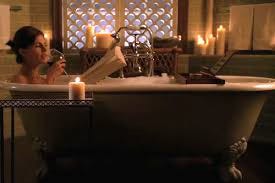
[Glyn makes an unsurprising choice of illustration, given the two options]
Poet 8: John
Incy-Wincy
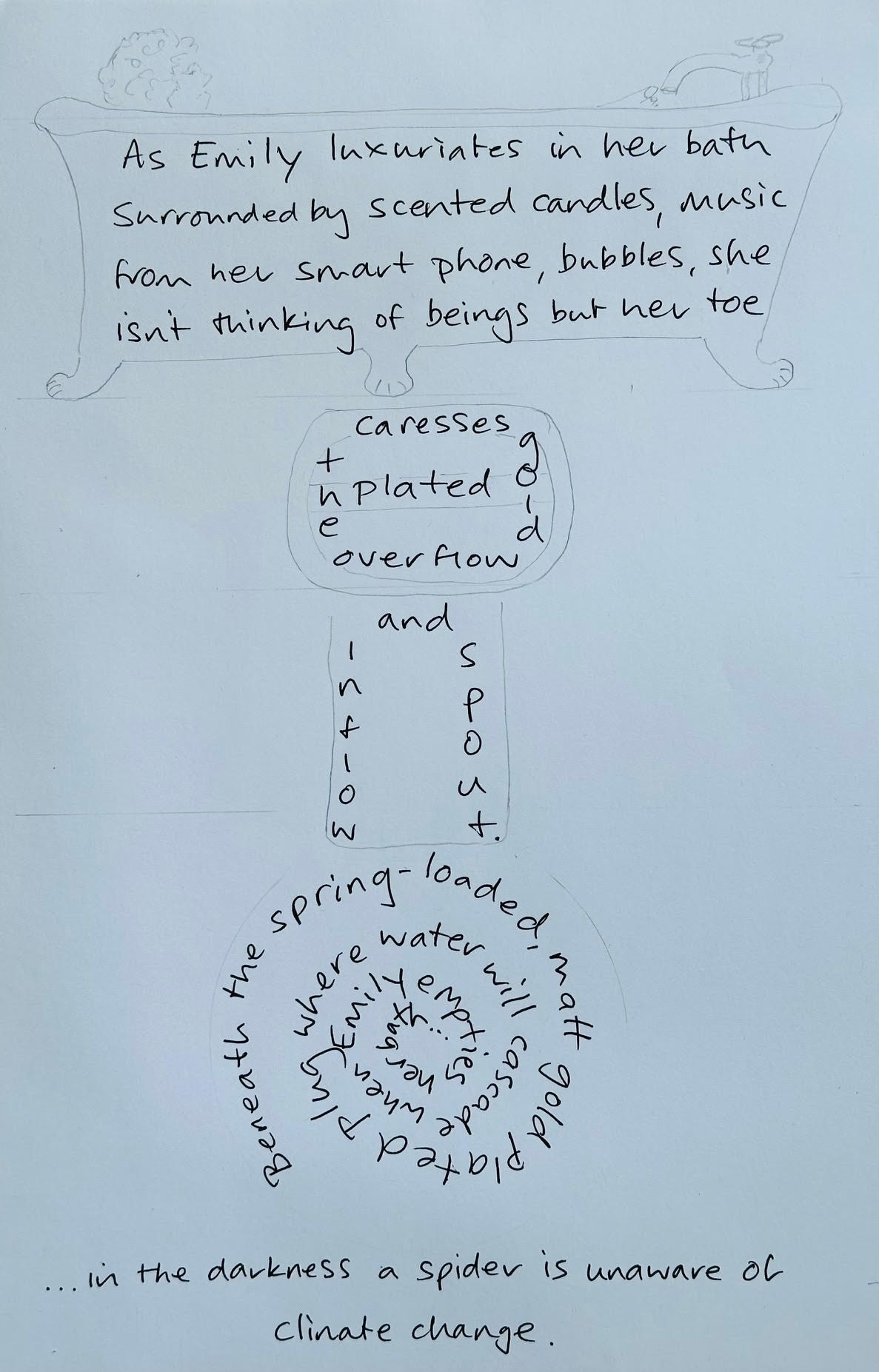
Glyn: I can’t say this format makes life easy for me! – but of course you’re right about pen v keyboard, and I’ll never get in the way of that decision! Especially not one made in the shower, I’ve been there…
Of course the thing about ‘concrete’ poetry is the reader is slightly trapped in a game of Do you see what I’ve done? which can be a little claustro…
But you’ve got your mis-en-scene, Emily and spider, good choice of name, good choice of creatures. I wouldn’t have known the first stanza was the bath-shape without the faint pencil-marks, I do like the spiral, but the last line feels pasted on, not of the moment and isn’t playing the concrete game.
Try this: how about expanding but simplifying the spatial moves, from bath towards spiral, water settled, water running away (like sense of safety), and really do this primal scene – it doesn’t get much more primal than CREATURE SCARES GIRL, from Eve to Eurydice to any kind of beauty-meets-a-terror! You’re having fruitful fun with the shaping – now have it with the scene – make her beautiful, bring the spider in earlier, unseen, do poetry’s version of the creepy Psycho music, scare the living daylights out of her and us? Then find out how it ends – shock yourself – go for it!
***

Poet 9: Por de Gisto
Sinai
Remember me, she says,
With eyes that sing of night,
Glittering as the first field of stars
From a time before cities.

Remember you?
Poor ghost, I try. And yet
Like that scattered map up there -
Seeming now exact, but then
As a gust of grains across a desert carpet -
The memory blows cold.

Who can recall the true tune of a sting,
The tang of light, the scent of a sigh?
You are something tables, records,
Even cameras cannot catch.
You are water poured
Through a veil of silk;
The weight seeps


And in time


Just a line

Remains.
Glyn: Great first line, can’t go wrong with that - moving in the shadow cast by the title - but l.2, sing of night feels too received as a phrase - perhaps you can strip back the first stanza a little, to help with that pre-history tone, like say
Remember me, she says,
With eyes that glitter
Like the first field of stars
In a time before cities.
That’s an austere template, but maybe add a 5th line, as I think this is a poem of 4 5-line stanzas? The regularity suggests a timeless pattern - which is in the Matter of the poem - so I would bring it into the Means as well. To keep both the lines and stanzas of a length - so the thing is four breaths in the presence of awe.
Remember you? Poor ghost,
I try. And yet up there...
I really like the idea of starting stanzas 1 and 2 with Remember. Perhaps the 3rd can diverge (which it does well, into Who can recall) and a last one comes back to Remember.
I like the capitals on the left margin, this is an undervalued resource. It renders a heraldic quality to the lines - makes them more like LINES - and it suggests a gravity, not seriousness (though that too) I mean the physical force of gravity, a pulling back towards the left margin as pulling back towards the source (which is also part of the Matter). Short lines bespeak a hostile open (white space) which the voice cannot probe far into. This suggests wildernesses of time and space, as the poem does.
The spatial gestures at the end are too conspicuous, the weight of the lines is already achieving the effect they’re pitching at.
This is a lyric poem, let the stanzas form a chorus. I think the last one should begin:
Remember. You are water
Poured through a veil of silk
etc
Try this: Four 5-line stanzas, resembling like footprints on desert sand. First, second and last begin with Remember. Regular stanzas are literally aides-memoire! I think the forming of the stanzas will give you both weight and light in word-choices, help to toughen the white space against the poem, which has the effect of toughening it.
***
The Road Not Taken
Robert Frost
Two roads diverged in a yellow wood,
And sorry I could not travel both
And be one traveler, long I stood
And looked down one as far as I could
To where it bent in the undergrowth;

Then took the other, as just as fair,
And having perhaps the better claim,
Because it was grassy and wanted wear;
Though as for that the passing there
Had worn them really about the same,

And both that morning equally lay
In leaves no step had trodden black.
Oh, I kept the first for another day!
Yet knowing how way leads on to way,
I doubted if I should ever come back.

I shall be telling this with a sigh
Somewhere ages and ages hence:
Two roads diverged in a wood, and I—
I took the one less traveled by,
And that has made all the difference.