
Enthooooooosiasm!!!
And other happy endings

The Creature in the Open
A talk I recently gave at the Institute of Psychoanalysis…
Part 3 of 3
Jaak Panksepp’s Seven Primary Emotional Systems in Mammals
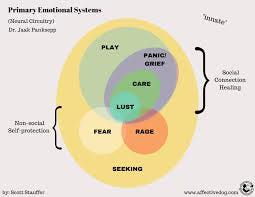
Panksepp capitalised the seven emotional systems, to distinguish them from their ordinary use in language, and, in the sequence he always uses in his taxonomy, by dint of their centrality in the brain – which may suggest a chronology to their evolution – they are: SEEKING, RAGE, FEAR, LUST, CARE, GRIEF/PANIC and PLAY.
I believe there is a suggestive, even instructive equality to these seven. Panksepp clearly felt that the SEEKING system underlay the rest – originally it was called the brain-reward system and it has other names though Panksepp always insisted on SEEKING, somewhere he called it ‘the goad without a goal’. But he often defined it – in his sweet, wry Estonian-American – as ENTHOOOOOOOSIASM, what gets you up in the morning with no definite idea of the destination, only knowing it’s worth going there. If I’m feeling good, I’m feeling that.
SEEKING is, in poetic terms, the Open itself, the white space when your capacity in the craft makes it come alive. You don’t know what you will make, but you know you will try.
Looking at the familiar medieval crew of RAGE, FEAR, LUST etc, there are some suggestive differences to their status in our culture. FEAR is not swollen by some monotheistic belief-system, the GRIEF system is about lost attachment, so it includes the joys of having that attachment. Here SEEKING rises to prominence. The child who tells you don’t tell me, I want to work it out for myself! That’s the SEEKING system at its purest.
There are also suggestive differences to their significance in Freudian psychology. Here CARE and PLAY have the same rights as RAGE and LUST. CARE and PLAY: this could be Anna Freud, Bowlby and Winnicott entering the conversation after Freud and Klein’s focusing on drives of life and death and sex. Some people suggest an eighth system might be SOCIAL DOMINANCE, but I wonder if that’s not just SEEKING plus some compound of RAGE and FEAR and LUST. When I doomscroll I tend to think so.
And as for PLAY, Panksepp himself mapped out the PLAY system, initially by recording the laughter of rats when you tickle them, which gave him his nickname, and he believed, as I do, that a strong PLAY system, like a strong SEEKING system, represents the best hope for curing or treating depression. This is indeed how much of his research was funded, and how much of it was targeted, and still is, by those who’ve followed in his steps.
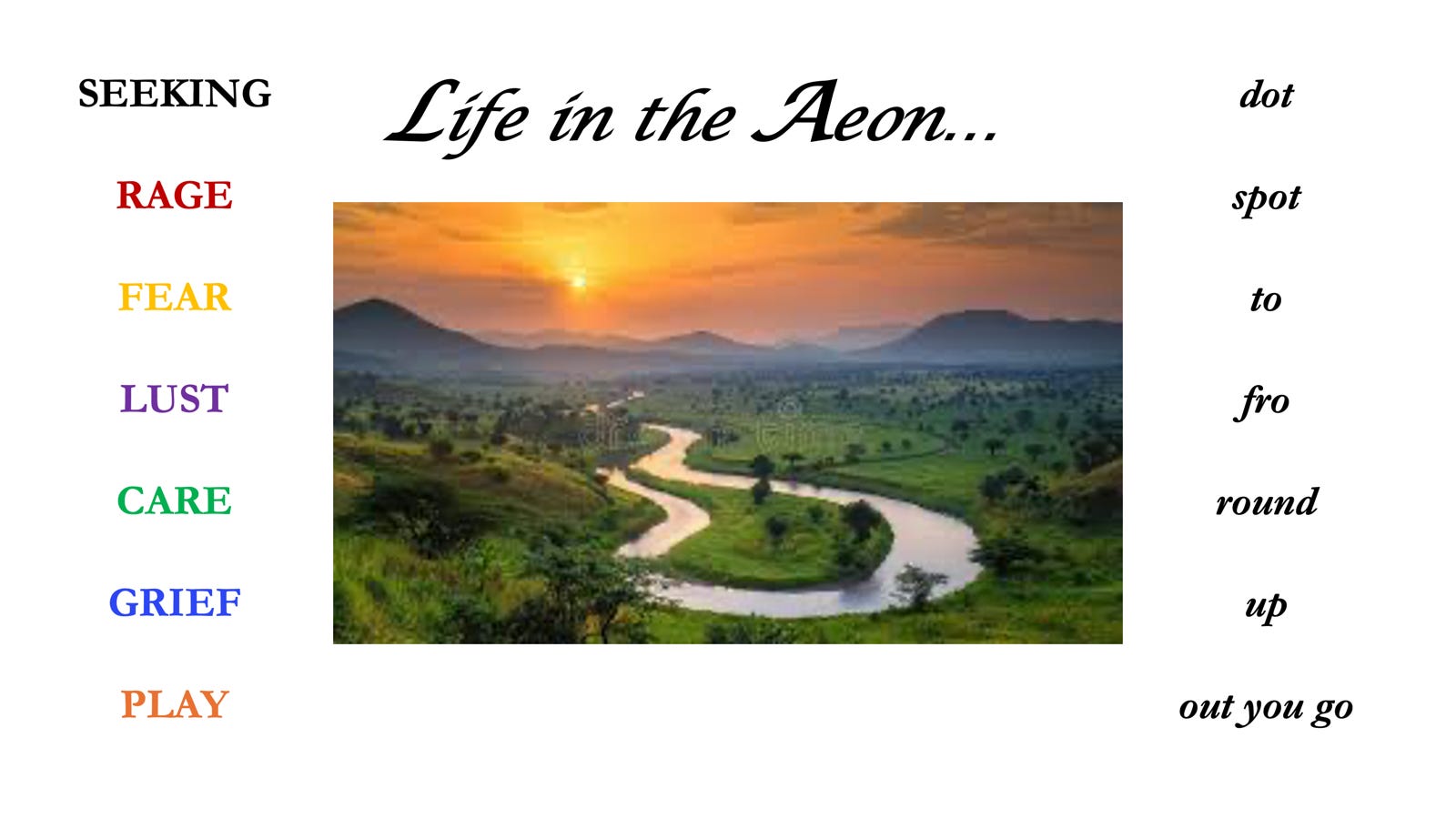
So there’s my rainbow, down the left side of the page. Seven colours, seven emotional systems, seven ages of man, seven major notes in music, I was born on a seventh, what is a boy to do?
You can look at these seven and play all sorts of parlour games: why isn’t there LOVE? I think it’s because love is SEEKING plus a combination of the others, hopefully more CARE and PLAY, LUST here and there now and then, an absence of RAGE or FEAR.
My brain can’t take neuroscience for too long, so let’s journey to the Intuition side of the spectrum, where you see my little nursery-rhyme scattered down the right margin: Dot, Spot, To and Fro, Round, and Up, and Out You Go. This is a toyshop version of the Seven Ages of Humankind, all the world’s a stage and so on, but I didn’t coin it consciously, it came to me in a dream. When I say Intuition, I mean at least that.
I think of the seven primary systems measuring out a day, and for that day I have repurposed the ancient word Aeon, a word which was once synonymous with life itself, and now means an indefinitely long time…
I am a mammal, I am a Creature in the Open, I hunt in the daylight, you know why? because the dinosaurs seem to have gone away… The centurion Attenborough told me that on television, and he’s the last thing left to believe.
So I wake at the dawn of a day that feels eternal and I know there’s something to be done! SEEKING. Life is all possibility as the sun lifts in the sky.
I grow thirsty, journey to the water’s edge – but there’s someone there already! Someone taking my space in the world! RAGE!
And what if there are more of them than one, more of them than me, or they’re stronger than me? FEAR!
Now it’s getting on for afternoon, I’d better find someone to hang around with me – LUST!
Excellent, now and look what we’ve gone and done – this little thing’s another one of us – we’d better CARE!
But afternoon goes by, and our little thing will go away, or one of us will go away – GRIEF –
and now the evening comes on, and the isolation of the sky, casual flocks of pigeons sinking downward to darkness on extended wings. Let’s break out the playing cards and the drinks, anyone who’s still around, and PLAY.
To think primally is to think kindly, to consider our kind.
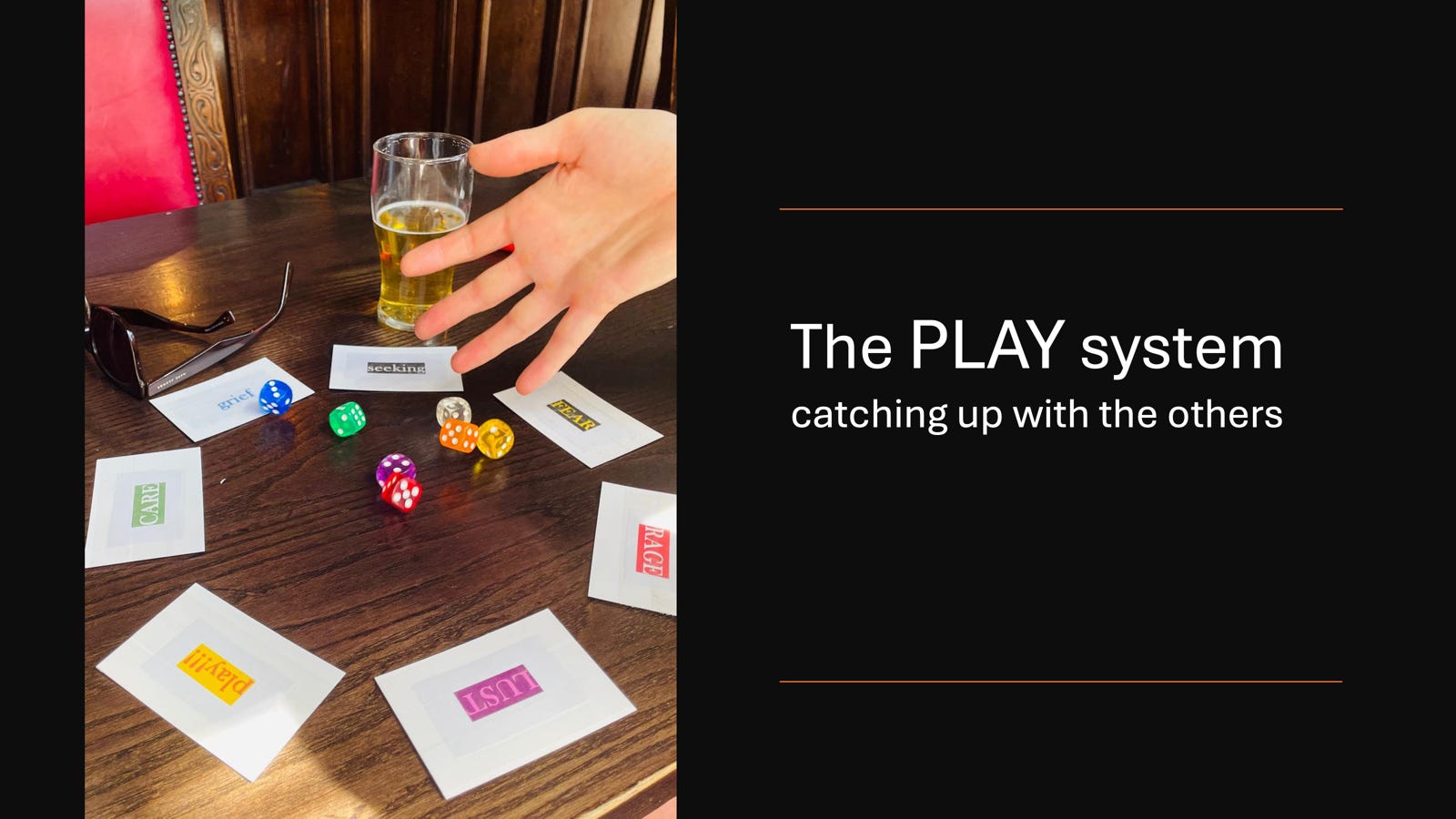
I carry seven coloured dice around with me, obviously: there they are in action. If you shake them and take the top two scores, call them prime and secondary motivators – I just did while writing this and got FEAR & PLAY, then CARE & LUST, then RAGE & PLAY – and then try and think of whom you know that this might describe. Hey presto, a character to consider, a way of seeing the world to try to imagine. And which ones are you?
I think Panksepp would have liked these games. He said this in an interview, about his ground-breaking book Affective Neuroscience before the scientific academy started opening up to his theories:
Surprisingly one of the first classes to use this book was at the State University of New York at Binghamton… people in the English Department invited me – it wasn’t in the Sciences – because they use my new book in the English course in poetry, and the students were asked to use these basic emotional systems to not only interpret some poetry but to write their own poetry. So some of this was their assignments, which of course makes me happy!
You can hear the joy in his voice.
Last Christmas I set up a poetry competition through Substack, in which poets who entered were asked to do just that, shake the dice and take the numbers. The quality of the poems was remarkable, I’ll do it again this year, it was called Jaak’n’Max’s Primary Systems Advent Calendar Poetry Prize. It will open for poems on Halloween.
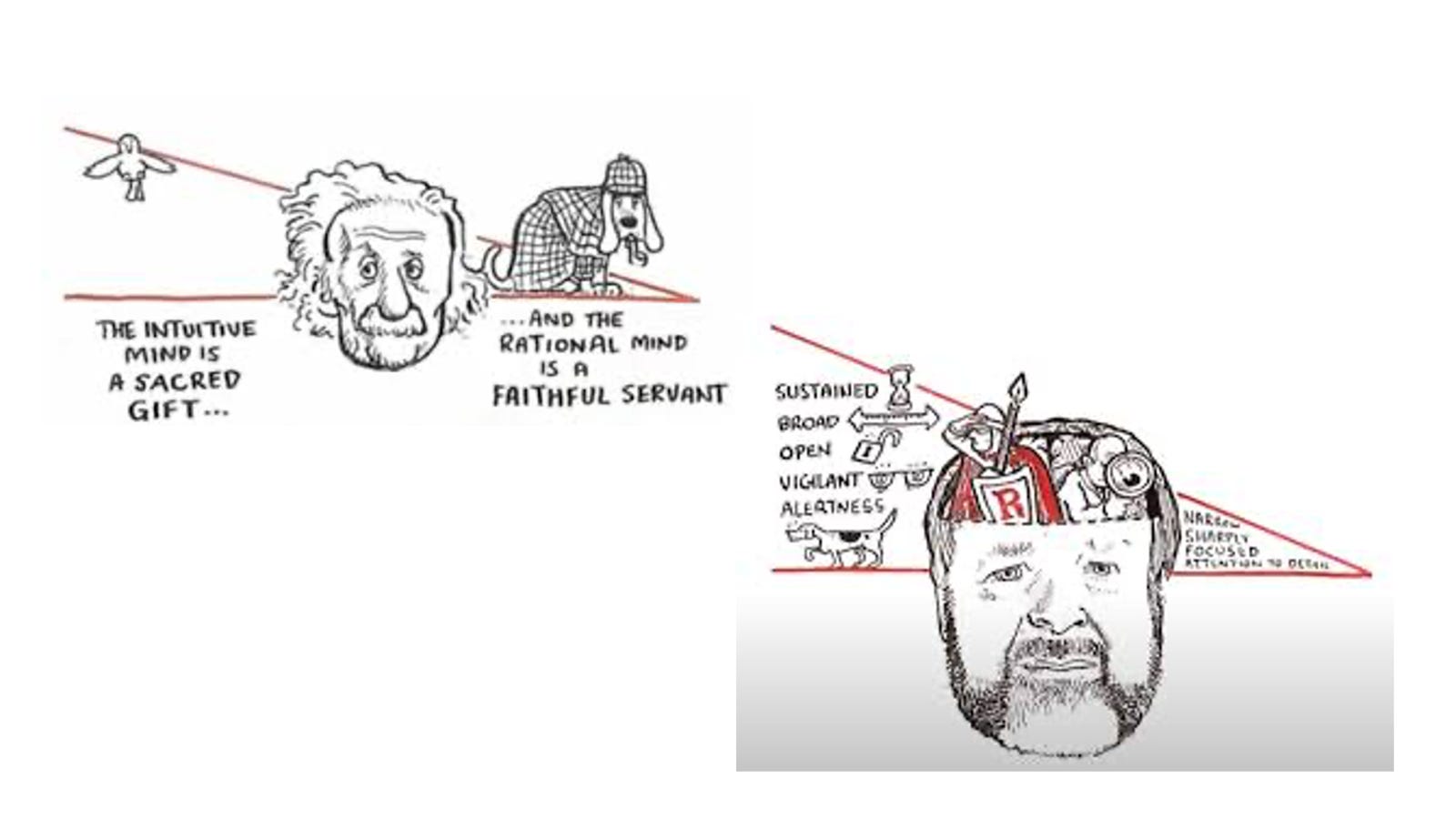
Other great scientists are available, and here are two more, the one on the right being a likeness of Iain McGilchrist, the psychiatrist and philosopher of, primarily, the brain’s right and left hemispheres. He often quotes the other fellow in the drawing: ‘The intuitive mind [the right hemisphere] is a sacred gift, and the rational mind [the left hemisphere] is a faithful servant.’ It is McGilchrist’s essential philosophical contention, albeit phrased in my vernacular, that the world is going to shit because the left side, mechanistic, controlling, bureaucratic has taken over from the right side, encompassing, imaginative, open to mystery.
I came up with Barcode and Rainbow before I’d read a word of Iain McGilchrist, or indeed met him, and if he asks, the names are taken.
Anyway we mean much the same thing, by the various strengths and weaknesses of our science, reason, imagination and intuition. If you haven’t read him you have a treat in store but for now, here’s a little example as it relates to our friend the Creature in the Open, and how it relates to poetry.
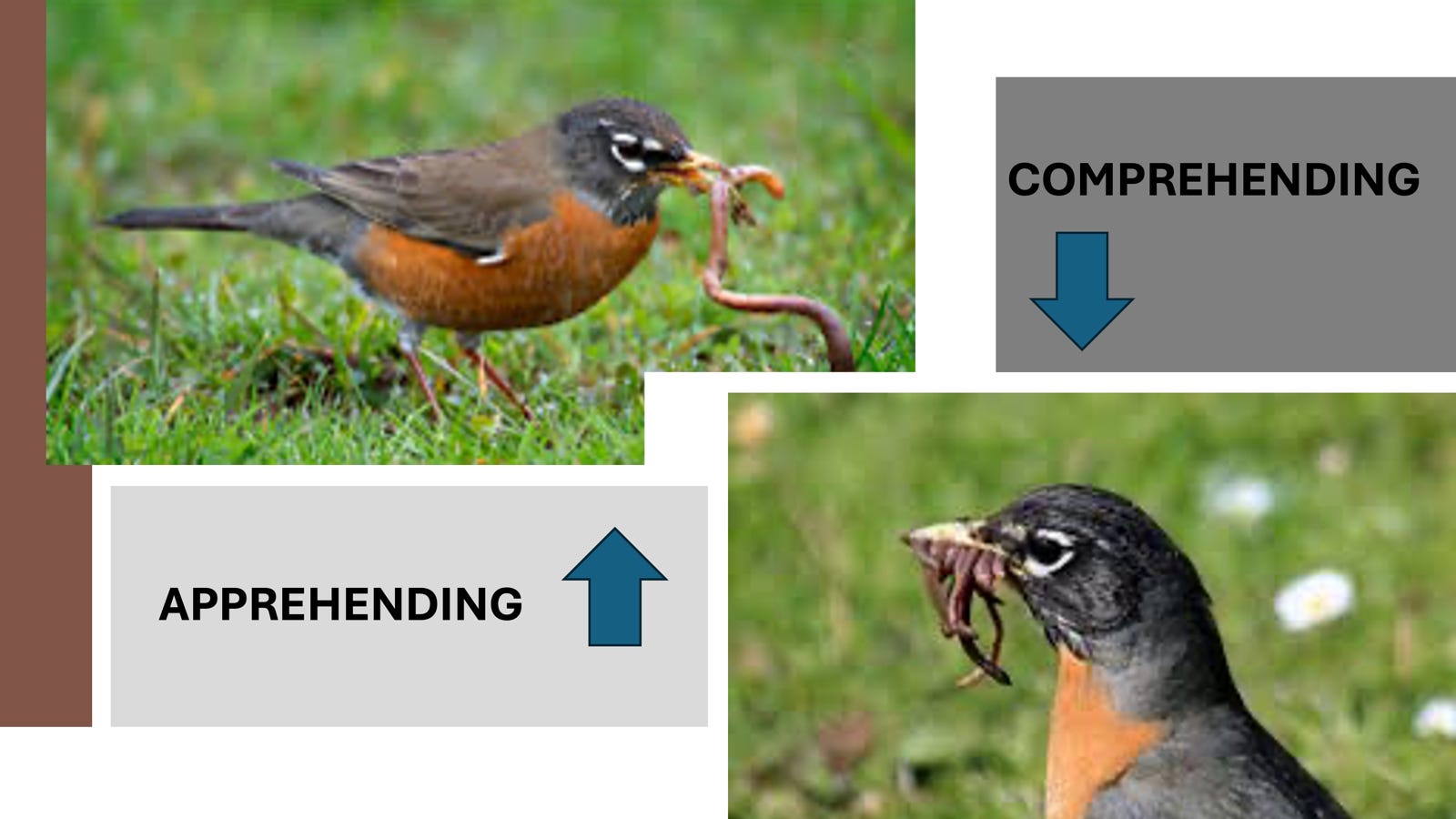
In birds, as in mammals, the right brain governs the left hand and vice versa, so the bird on the left is catching the worm because she is using the side of the brain that grasps something it needs, to the exclusion of everything else. This is Barcode in action. But according to McGilchrist, and this really does seem a strong scientific consensus, the whole point of having two hemispheres in the brain is so they can do different tasks. They can attend differently. ‘Attention is a moral act,’ writes McGilchrist.
Hence the bird on the right. While the right eye/left side apprehends, which means grasps, the left eye/right side is comprehending, which in this context means looking out for predators while she does what he has to. This is indeed why we have asymmetry in the brain, why the hemispheres evolved so differently.
And what’s this got to do with poetry? Well, what if left-brain poems were serving functions such as these – and I can list them because I’ve felt them all in my time and I’m sure you can find some of yours in there too…
Here’s the apprehending of a poem: also known as ‘a worm in the mouth and nothing else matters’:
I get better at this. I impress people around me. I surprise myself. I point out things are like other things. I sound a bit like my heroes. I show my parents it was worth it all along. I get applause. I get employed. I become more attractive. I seem interesting and deep. I am borne in mind.
[a young poet thinking those kinds of things]
Meanwhile what’s the right brain doing, the Rainbow side, what’s the left eye watching for, with the worm a mere detail and a whole landscape to contemplate? Am I safe? are my kind safe? will this help us? is there time?
Fast forward in evolution from our bird to our kind on the primal savannah, the early human painting the cave wall, the first art that survived the future, and the functions might be something more like this:
What’s our story? what went wrong and is it going wrong again? can I make the passing days better, kinder, or sweeter, either way more comprehensible? Can these words be handed down through generations of us, to us?
How many poems are thinking like this? The poem may be good in all manner or means of ways. Is it a good poem by its own lights? Well done you. But has the poem been written in the light of our kind, or by the light of the world?
So… the Creature in the Open, crossing the savannah. As I wrote at the opening of On Poetry, on the back of theories found in evolutionary biology, long before I became to my surprise a poet who reads more neuroscience than poetry, what we think is beautiful is probably what we need for the purposes of nourishment, safety, company, curiosity – what I now would call the SEEKING system. But well, I would, wouldn’t I.
I’ll round off with another reprise from last year. What are these?
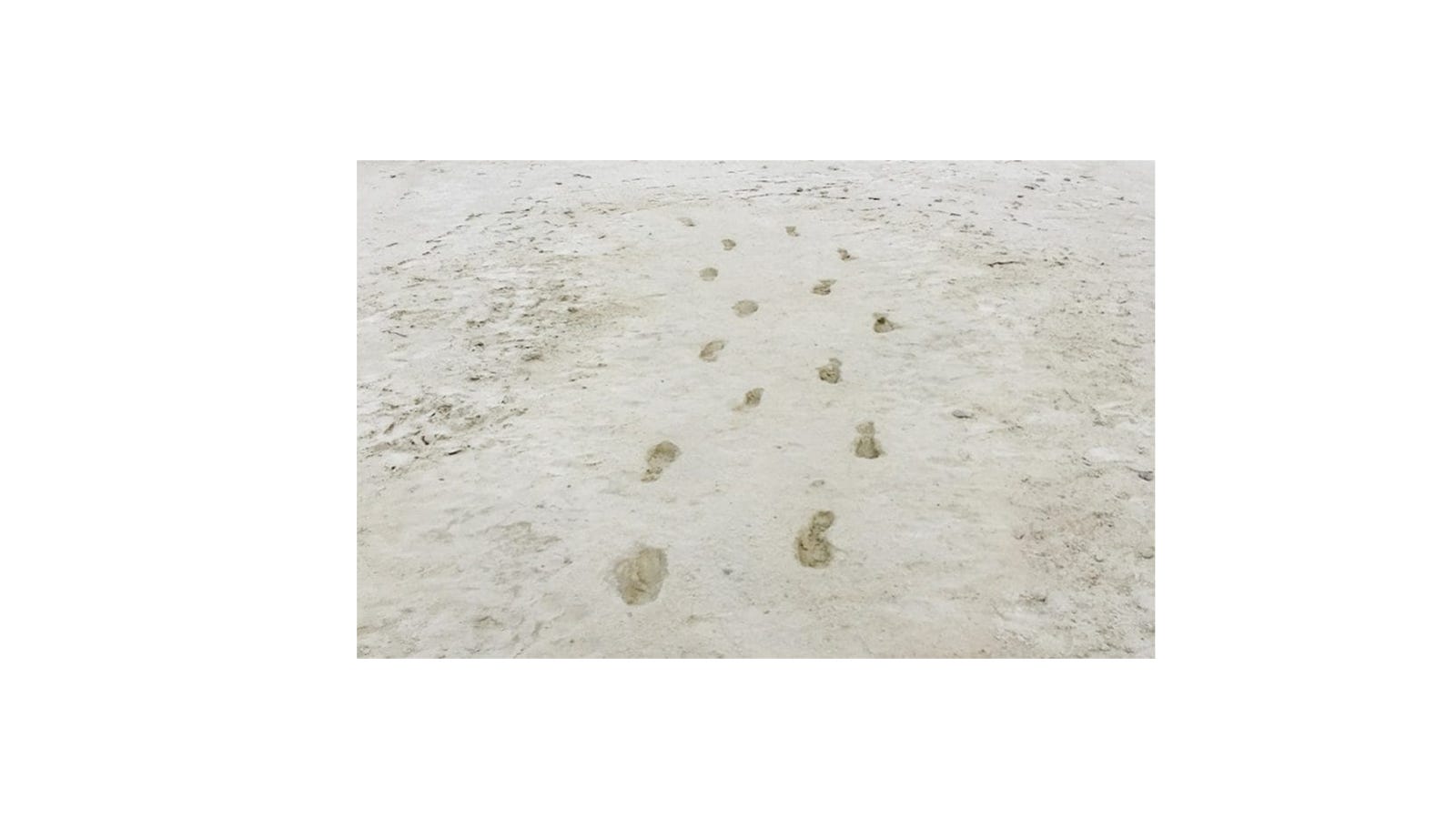
These are fossilized footprints from the Arizona desert. What’s the story here? I’m sure you can work it out…
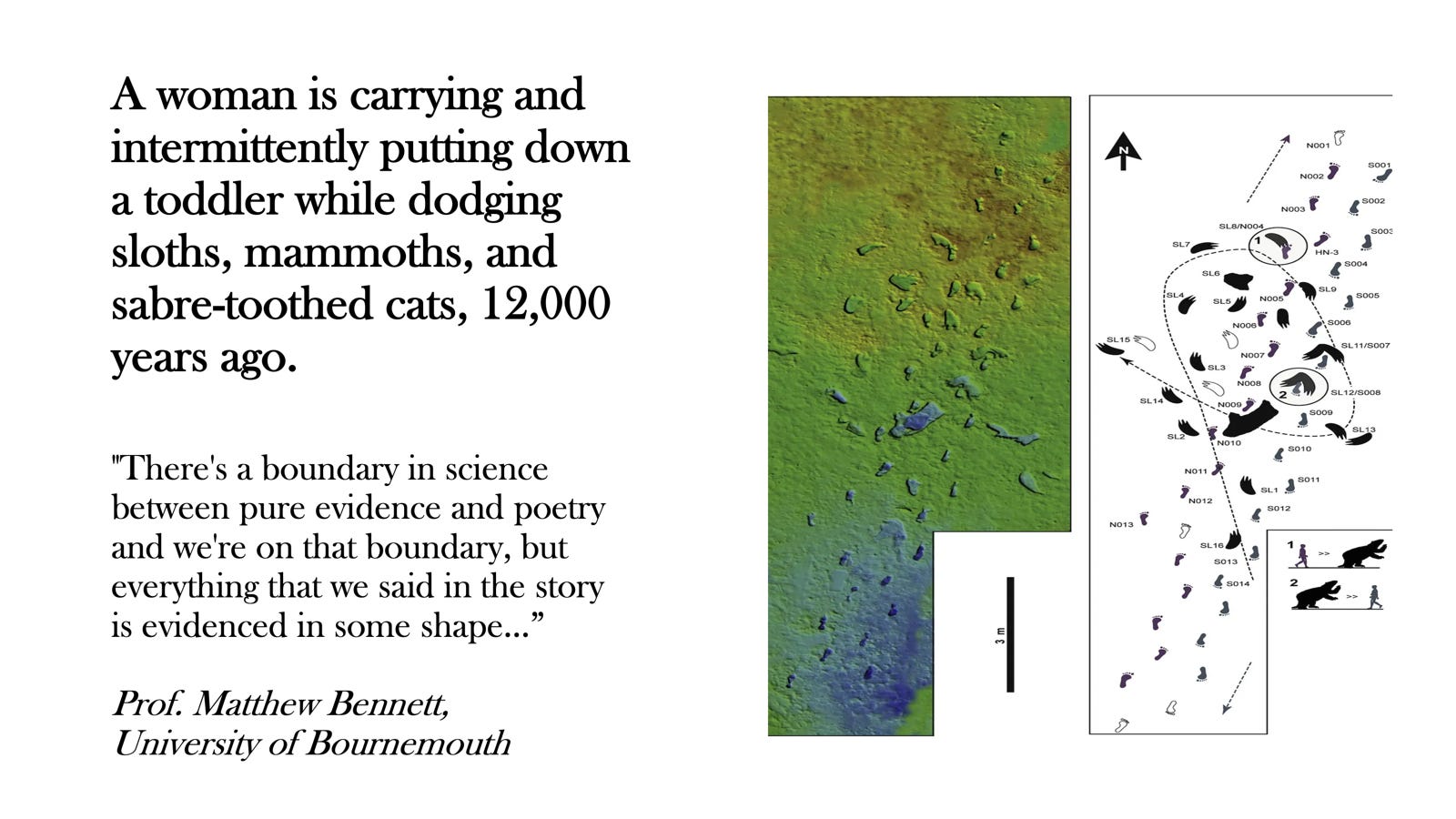
Exactly. A woman is carrying and intermittently putting down her toddler while dodging sloths, mammoths, and sabre-toothed cats. And at one point the cats feel fear and run away because they can smell the mammoth. It’s all pretty straightforward! Those markings on the right, there’s a poem for you that’s looking with both eyes, and has our kind at heart.
Or as has been said before and should be said again for what’s left of time: ‘The only people on the earth are women and their children.’
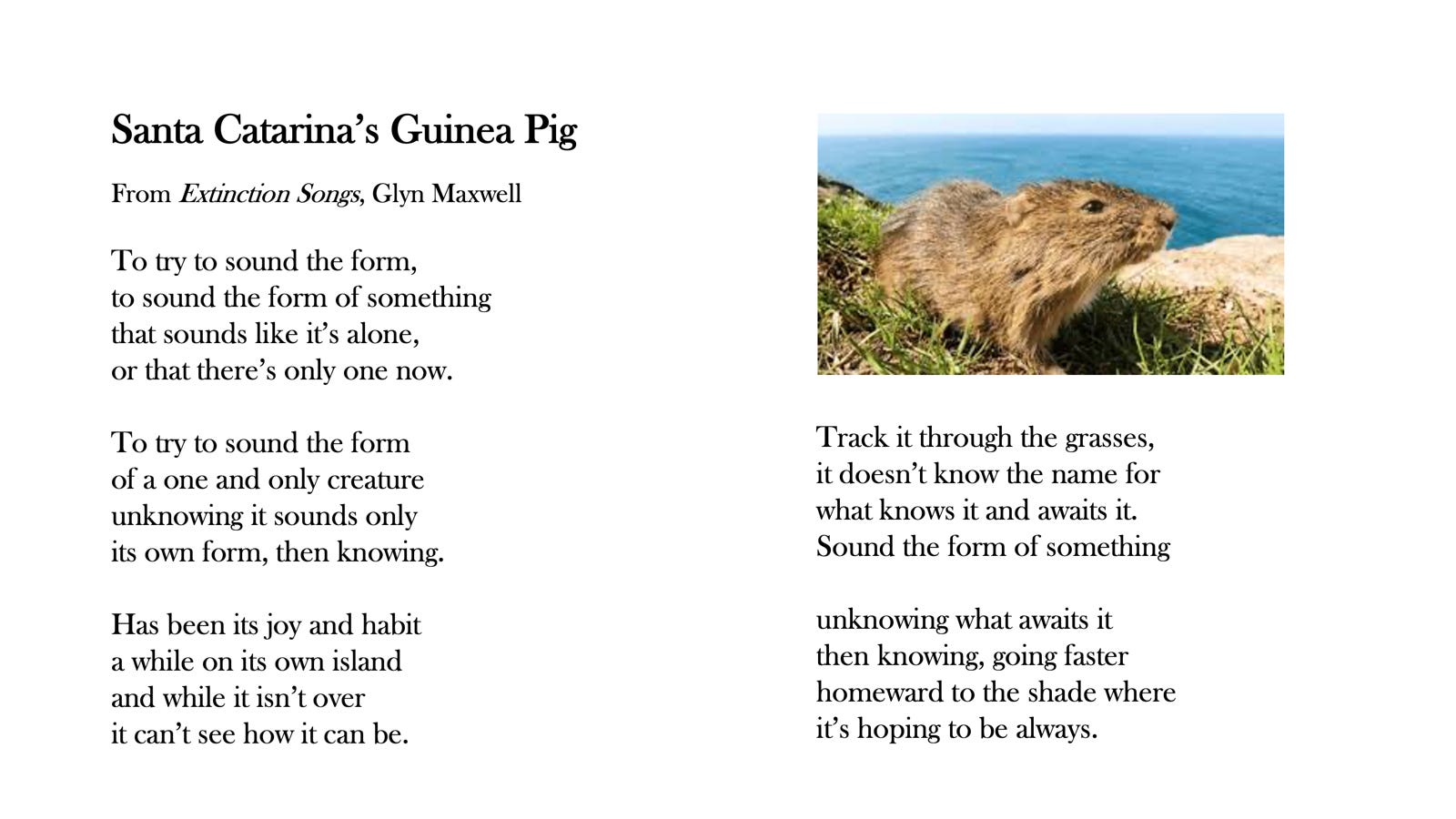
I conclude with no particular conclusion. These are notes towards a book, they all have their hands up and I don’t know whom to call upon. But heigh-ho, some consolations for the Creature in the Open, some metaphors to think about, science, reason, imagination, intuition, and one final curve in the spiral, the same poem from last year, the poem of Santa Catarina’s Guinea Pig, the world’s rarest mammal. Only sixty of them at most remain on earth. Well, as a Mandy Rice-Davies might have phrased it, that’s fifty-nine more than there are of you or me.
***
‘The Creature in the Open’ was delivered on 1st June 2026 at 10 Windsor Walk, as part of the IOPA’s Maudsley Lectures in Psychoanalysis series, Writing and the Unconscious.
Note: in the second part of the lecture (posted yesterday) I wrote ‘your poetry too is in thrall to morality.’ It’s a typo, I mean ‘mortality’ - not an insignificant difference. ffs.