A course on Mr Walcott
coming up in June...

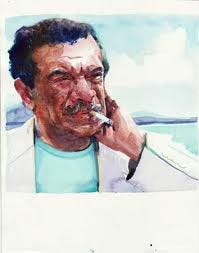
Here’s an online course I’m going to teach, it will be held on three Mondays in June: 8th, 22nd and 29th, from 6.30 to 8.30.
I’ll do some close reading of favourite poems, which I’ll tell you in advance so you can join in; I’ll talk about his style of writing, of teaching, what it’s like to find oneself in such a remarkable mentor/mentee relationship, answer questions, tell about some good times and bad, set some relevant writing exercises.
£90 for the whole, then again I’m the only person there is who both is a poet and was a close friend.
Message me here or DM on Facebook or email if you have it.
Here below are two poems I wrote about him. There was a time when anyone who visited his house in St Lucia was obliged to attempt a watercolour of Pigeon Island - which dominated the view from his place - and sure enough in the summer of 1999 he demanded that my then wife (who can paint) and I (who can’t) essay this. Our pictures are presumably somewhere in deep storage; here is what we were trying to capture…
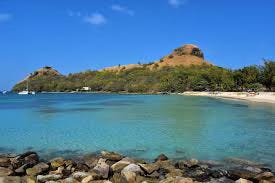
[Pigeon Island in action]
Of course, he didn’t really want me to capture it at all. He would tell me what all the local flowers and trees were called - alopecia, belafonte, cannelloni, cowabunga - so I’d put them into poems and make a twat of myself.
Anyway, good times. I was his MA student twelve years before this holiday, and we both enjoyed the return to that relationship: me to start somewhere at zero again, he finding a new art-form in which to judge me inept.
These two poems are stylistically as close to Walcott’s work as I ever tried to get - inevitable perhaps - this first one is more visual than I remember being. I’m glad I got limeade in.
***
Island Painting, St Lucia (1999)
Once under the one hoisted tent of noon
we set to watercolours in the shade;
I went for green and dabbed it on too soon,
	I made limeade
	of every water glass.

The ever-painted island let a towel
of shadow round it till it all was dry;
our teacher looked and set a lasting vowel
	down as I
	uncapped ultramarine.

Recurring errors I could term a style,
I joked to you and made one as I did,
where the still-damp wash was tipped with wet detail
	and was all blurred
	to blazes. I sat back:

already you were starting on the tree
I judged beyond me; you had three pale ochres
working on it. I had a midnight sea
	with violet breakers
	which were not the case

and, cheating, I had had the horizon ruled
though still it fizzled; yours was the true line
that draws a beam on the retreating world,
	is the one sign
	we learn from its long passing.

Your brushes idled in their Evian;
mine mutinied in ink. Our teacher watched
his ocean darken. ‘Not too heavy on –
	too late.’ He reached
	his hand out to his island,

gravely observed the cartoon foliage
I’d heaped on it, then riffled through my pad
to the relieving cool of a blank page.
	At least I had
	one picture true to light.

When he was gone my palette boiled with browns
unknown to man; I mixed at it until
I found one colour true among the stains;
	upon the hill’s
	dark back I added that.

The hour came to meet the green you made
too soon this morning, you were ready now,
leaf-confident. My move into deep red
	had ended how
	all movies end, all wrong.

The sky I’d dawdled over was a blue
it wouldn’t recognise as one. The clouds
I’d given it were gaps; they were the few
	shapes in God’s
	heaven that can’t be clouds

and can’t be helped. How much of this can be?
The water in the glass can look like water,
the brushes be made pure, and steadily
	held towards the
	island, the sharp pencil

can judge the distance. We can do this better,
render the remaining thing before
there are no colours, and our patient teacher
	comes to the door
	to offer fish or chicken.

The lamps went on and things were cleared away.
We swapped our works and liked each other’s most
for what had spoiled them. So was the best day
	over. The west
	had finished too, its piece

a squinting four-eyed creature, two right arms
extended to the evening sea, each
bearing a pencil, framed by the olive palms
	of one who’ll teach
	the simple things for ages.
The other poem is my elegy for him, written two years after he departed.
***
Thirty Years (2019)
I’m off the phone with Boston and it seems
I’m going there, I’ll tell them in a moment.
I’ll tell my folks about it, though your name’s
unknown to them and new to me. I open
the door to where they’re talking
	in our living room in summer

in the nineteen-eighties. – Now it’s afternoon.
That Everyman of light is turning helpless
hour by hour, retiring to a den.
Now the call to you, sir, now it’s fruitless.
My speckled hand is falling
	towards the blank account-book

to leaf through in the leavings of a Sunday.
Nothing written yet and the clock points.
My reading lamp reflects on the black window
itself alone: no lawn or neighbour’s fence,
no trees or distant bedroom
	glow to tilt the mind.

My empty page is a suburban silence,
earnest, available, where nothing goes
at night, here too there are so many islands,
mon professeur, and silence I suppose
was pretty much the sound
	I made in our one-to-ones.

Watching as you scanned some early effort.
Retracting it too late as clouds were looked to.
Clouds are looked to now, wish I’d been better,
a better friend, you breathing, me about to,
my heart accelerating
	towards your breaking judgment.

Your empty page was ocean, is still ocean,
lapping the ribs of this. If it’s a blank page
anything like mine it sees no reason
to think you won’t be back, mistakes the hush
for inhalation, waits
        ecstatically for more.

But it isn’t coming in, the light, the heat.
The handle’s not about to turn this scene
to us lot sitting where we used to sit,
our ballpoints circling what we think you mean,
our notebooks gaping wide
	on a cold and frosty morning.

Perpetually they wait between the waves,
clear pages yet to come: each one assumes
the turn is coming soon, each one believes
itself the first, like me in that bright room
in Boston, seen clean through,
	man alone with mentor,

turned, what days are for. But nothing turns
now, and nothing breaks. Your own blank page
was ocean, is still ocean going on,
and mine is nothing dining on the edge
of everything. You’re there,
	the fixed important jaw,

at the end of a long table, you who were,
pestered by some spectral fans too shy
to say they’ve heard your joke – I haven’t, sir,
let’s hear it. Look there’s nothing of the kind
there at all, but all
	I do in verse these days

is scry the empty page for signs enough.
Love and delight rear up in cliffs and caverns,
forms from Hubble light my heart and home-life,
but on the page? The pure white scrolling heavens,
sod-all else for story
        hereabouts. So help me,

for I knew you for a spell and now you’re not,
and my worn hand’s still guided like it was
when I was slick. There is a breath in earshot
which isn’t always mine, the wince is yours
when the line-break’s wrong, the groan
	when I reckon something’s finished.

I reckon something’s finished, that’s my only
reckoning as evening yawns and stretches.
If Everyman was here he wasn’t lonely,
for a visitor came by and she stayed ages,
and when they went a book went,
	songs in all its spaces,

a time accounted for. – It’s Sunday evening
in a rose-lit living-room, the open arms
of two old chairs, grey cushions, a clock ticking.
I’m off the phone with Boston and it seems
I’m going there, I told them,
	I’m flying in late August,

and there I’ll learn my light from dark, my right
delighted scribbling hand from my poor left
there listening one, and how they meet
between the lines, before the weeping crest,
beyond the raging fall –
	or words to that effect –

then I’ll come home a fool with a filled book.
Thirty years. The living and the gone
may meet here too, they’re here now if you look,
sir, in their shy accord, their one-to-one
that sounds the sound of heartbeats
	pattering through silence.